


€ 99,99 Gratis verzending

Uitgelicht
|
|
99,99 |
Naar shop
|

|
107,02 |
Naar shop
|
| VERGELIJK ALLE AANBIEDERS (2) | ||
 Beschrijving
Vergelijk aanbieders (2)
€ 99,99 Gratis verzending
€ 107,02 Gratis verzending
Winkels met andere maten
Beschrijving
(1)
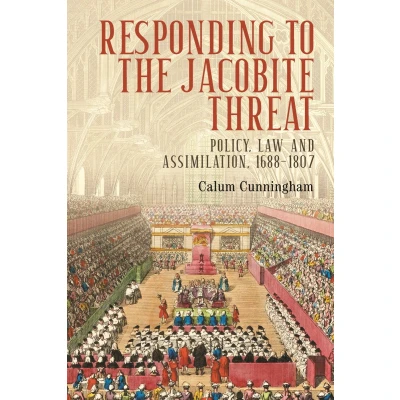
This book examines how various states and governments collectively responded to the Jacobite threat during the long eighteenth century. It emphasises the strategies and methods employed to dismantle Jacobitism and prevent a Jacobite restoration, thereby ensuring the Protestant Succession and the stability of the British State. Responding to the Jacobite threat examines how both Crown and State reacted to the dangers presented by Jacobitism across the ‘long eighteenth century’, from 1688 to 1807. The book offers a unique analysis of measures beyond military actions aimed at countering the Jacobite movement and its foreign supporters. Cunningham argues that Jacobitism became a significant risk to all levels of the post-1688 established order. He further contends that the Jacobites fundamentally challenged the formation and continued existence of the British State, necessitating an ongoing politico-legal response to the threat until the later eighteenth century.This study investigates how successive governments used institutional memory and administrative precedents to either criminalise or decriminalise Jacobitism politically, depending on the perceived threat at different times. Cunningham surveys various forms of State weaponry to illustrate the complex and interconnected strategies employed to destroy Jacobitism. New research scrutinises a wide range of sources, including State papers, Cabinet correspondence, policy-related memoranda, public legislation and relevant punishment data. The book ultimately demonstrates how the British State utilised all civic mechanisms to eliminate the substantial threat posed by the Jacobites to both the Revolution of 1688–9 and the Union of 1707.‘The first comprehensive survey of how the English, Scottish and Irish States responded to the Jacobite threat.’– Daniel Szechi, Emeritus Professor of History, University of Manchester and Honorary Professor in Irish and Scottish Studies, University of Aberdeen‘A strikingly detailed evaluation of government policy towards the Jacobite risings, with remarkable scholarship on legislation and its implementation.’– Murray Pittock, Pro-Vice Principal and Bradley Chair of English Literature, University of Glasgow‘Lucidly presented and diligently executed […] The endeavours of various iterations of the Scottish, English and British States […] are forensically examined.’– Allan I. Macinnes, Emeritus Professor of History, University of Strathclyde and Honorary Professor in Irish and Scottish Studies, University of Aberdeen In this first comprehensive monograph to examine the Jacobite threat from the perspective of its opponents, Cunningham investigates the mechanisms employed by states across the British Isles to eliminate this significant danger. Drawing on original primary research and data analysis, the study illustrates the complexity and scope of the politico-legal responses required to eradicate Jacobitism, responses that shaped all social classes and spheres within the three kingdoms. The book shows how numerous governments adopted a balanced approach that combined punishment with clemency, seeking both to deter rebellion by making its consequences clear and to reintegrate as many former state enemies as possible. By utilising institutional memory and administrative precedents to address the ‘Jacobite problem’, the British State ultimately dismantled the eighteenth-century socio-political structures that allowed Jacobite ideology to persist, destroying its remaining influence.
 Prijshistorie
 * Prijshistorie bevat geen data van Amazon.
Prijzen voor het laatst bijgewerkt op:
 Gerelateerde resultaten
 Productspecificaties


