
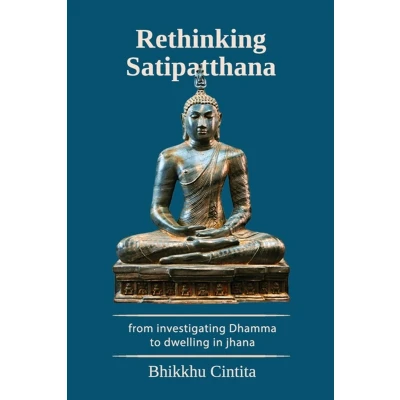
Rethinking Satipatthana: from investigating Dhamma to dwelling in jhana
Uitgelicht

|
10,59 |
Naar shop
|

|
10,59 |
Naar shop
|

|
13,00 |
Naar shop
|
| VERGELIJK ALLE AANBIEDERS (3) | ||
 Beschrijving
Bol
Satipä¿h¿na ("Foundations of mindfulness") is the Buddha's method of wisdom contemplation, best known through the early Satipä¿h¿na Sutta, which certainly ranks one of the most studied in the Pali Canon. Unfortunately, there is much in it that is interpreted neither consistently nor convincingly, including the role it demands for jh¿na. Rethinking Satipä¿h¿na is a critical rereading and reevaluation of the early teachings that vindicates the Sutta as well-composed, coherent and functionally straightforward in virtually all of its details. Satipä¿h¿na is the practice of investigation that develops the skill of apprehension in Dhammic terms. It selects a particular Dhamma teaching, then investigates, verifies and internalizes it in terms of direct experience. Although it focuses on impermanence and non-self, it is applicable to a large range of experientially based teachings. As in the acquisition of any advanced skill-from playing the cello to driving a car- satipä¿h¿na begins with a conceptual basis, that through repetition is internalized as increasingly effortless know-how, even while the content of the skill remains the same. The end result is immediate and spontaneous "knowledge and vision," effectively seeing through the eyes of the Buddha. Progressive stillness in jh¿na proceeds in step with the progressive effortlessness of Dhammic know-how.


 Beschrijving
(1)
Beschrijving
(1)
Satipä¿h¿na ("Foundations of mindfulness") is the Buddha's method of wisdom contemplation, best known through the early Satipä¿h¿na Sutta, which certainly ranks one of the most studied in the Pali Canon. Unfortunately, there is much in it that is interpreted neither consistently nor convincingly, including the role it demands for jh¿na. Rethinking Satipä¿h¿na is a critical rereading and reevaluation of the early teachings that vindicates the Sutta as well-composed, coherent and functionally straightforward in virtually all of its details. Satipä¿h¿na is the practice of investigation that develops the skill of apprehension in Dhammic terms. It selects a particular Dhamma teaching, then investigates, verifies and internalizes it in terms of direct experience. Although it focuses on impermanence and non-self, it is applicable to a large range of experientially based teachings. As in the acquisition of any advanced skill-from playing the cello to driving a car- satipä¿h¿na begins with a conceptual basis, that through repetition is internalized as increasingly effortless know-how, even while the content of the skill remains the same. The end result is immediate and spontaneous "knowledge and vision," effectively seeing through the eyes of the Buddha. Progressive stillness in jh¿na proceeds in step with the progressive effortlessness of Dhammic know-how.
 Productspecificaties
 Prijshistorie
* Prijshistorie bevat geen data van Amazon, Amazon Marketplace.
Prijzen voor het laatst bijgewerkt op:
 Gerelateerde resultaten


