








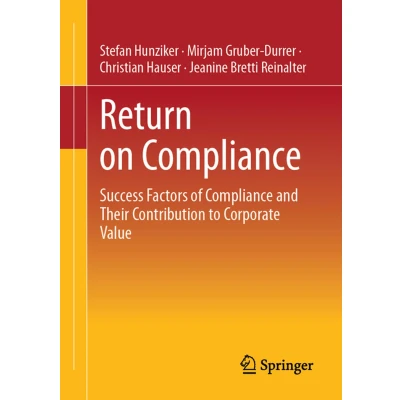
Return on Compliance
Uitgelicht

|
69,99 |
Naar shop
|
 Beschrijving
Bol
To this end, a scientifically grounded compliance model has been developed, which can demonstrate the connection between successful compliance and corporate success, representing a "paradigm shift in the approach to compliance." "Compliance" is now considered a fundamental requirement for the "license to operate" and represents a critical management function for companies. Numerous corporate scandals related to compliance violations suggest that companies are not always able to manage enterprise-wide compliance risks adequately. This is partly due to the lack of an established procedure for evaluating compliance success. As a result, there is a legitimacy problem for responsible leaders, as compliance expenditures are difficult to justify. Therefore, compliance must no longer be viewed as a cost factor but as a demonstrably value-adding management tool. This Quick Guide illustrates how the value contribution of compliance can be optimized in medium-sized and large companies. Contents Compliance as a balancing act between costs and benefits Empirical insights from the compliance success model Recommendations for optimizing compliance success The Authors Prof. Dr. habil. Stefan Hunziker is a Professor of Risk Management at the Institute of Financial Services Zug (IFZ) at the Lucerne University of Applied Sciences and Arts. Prof. Dr. Mirjam Gruber-Durrer is a Professor of Normative Board Management at the Institute of Financial Services Zug (IFZ) at the Lucerne University of Applied Sciences and Arts. Prof. Dr. Christian Hauser is a Professor of Business Economics and International Management at the Swiss Institute for Entrepreneurship (SIFE) at the University of Applied Sciences of the Grisons. Jeanine Bretti Rainalter is a research assistant at the Swiss Institute for Entrepreneurship (SIFE) at the University of Applied Sciences of the Grisons. The translation was done with the help of artificial intelligence. A subsequent human revision was done primarily in terms of content. This book is a translation of an original German edition. The translation was done with the help of artificial intelligence (machine translation by the service DeepL.com). A subsequent human revision was done primarily in terms of content, so that the book will read stylistically differently from a conventional translation. "Compliance" is now considered a fundamental prerequisite for the "license to operate" and is therefore a critical management function for organizations, requiring significant resource commitment. Numerous corporate scandals related to compliance violations suggest that companies are not always able to manage enterprise-wide compliance risks appropriately. This is partly due to the lack of an established method for quantifying the success of compliance efforts. As a result, a legitimacy problem arises for the responsible executives, as the (high) compliance expenditures are difficult to justify. This book addresses this challenge and demonstrates how the success and value contribution of compliance can be optimized in medium-sized and large companies. To this end, a scientifically grounded compliance model has been developed, which can demonstrate the connection between successful compliance and corporate success, representing a "paradigm shift in the approach to compliance." Compliance must no longer be seen as a cost factor but as a verifiably value-creating leadership tool.


Vergelijk aanbieders (1)

 Beschrijving
(1)
Beschrijving
(1)
To this end, a scientifically grounded compliance model has been developed, which can demonstrate the connection between successful compliance and corporate success, representing a "paradigm shift in the approach to compliance." "Compliance" is now considered a fundamental requirement for the "license to operate" and represents a critical management function for companies. Numerous corporate scandals related to compliance violations suggest that companies are not always able to manage enterprise-wide compliance risks adequately. This is partly due to the lack of an established procedure for evaluating compliance success. As a result, there is a legitimacy problem for responsible leaders, as compliance expenditures are difficult to justify. Therefore, compliance must no longer be viewed as a cost factor but as a demonstrably value-adding management tool. This Quick Guide illustrates how the value contribution of compliance can be optimized in medium-sized and large companies. Contents Compliance as a balancing act between costs and benefits Empirical insights from the compliance success model Recommendations for optimizing compliance success The Authors Prof. Dr. habil. Stefan Hunziker is a Professor of Risk Management at the Institute of Financial Services Zug (IFZ) at the Lucerne University of Applied Sciences and Arts. Prof. Dr. Mirjam Gruber-Durrer is a Professor of Normative Board Management at the Institute of Financial Services Zug (IFZ) at the Lucerne University of Applied Sciences and Arts. Prof. Dr. Christian Hauser is a Professor of Business Economics and International Management at the Swiss Institute for Entrepreneurship (SIFE) at the University of Applied Sciences of the Grisons. Jeanine Bretti Rainalter is a research assistant at the Swiss Institute for Entrepreneurship (SIFE) at the University of Applied Sciences of the Grisons. The translation was done with the help of artificial intelligence. A subsequent human revision was done primarily in terms of content. This book is a translation of an original German edition. The translation was done with the help of artificial intelligence (machine translation by the service DeepL.com). A subsequent human revision was done primarily in terms of content, so that the book will read stylistically differently from a conventional translation. "Compliance" is now considered a fundamental prerequisite for the "license to operate" and is therefore a critical management function for organizations, requiring significant resource commitment. Numerous corporate scandals related to compliance violations suggest that companies are not always able to manage enterprise-wide compliance risks appropriately. This is partly due to the lack of an established method for quantifying the success of compliance efforts. As a result, a legitimacy problem arises for the responsible executives, as the (high) compliance expenditures are difficult to justify. This book addresses this challenge and demonstrates how the success and value contribution of compliance can be optimized in medium-sized and large companies. To this end, a scientifically grounded compliance model has been developed, which can demonstrate the connection between successful compliance and corporate success, representing a "paradigm shift in the approach to compliance." Compliance must no longer be seen as a cost factor but as a verifiably value-creating leadership tool.
 Productspecificaties
| EAN |
|
|---|---|
| Maat |
|
 Prijshistorie
Prijzen voor het laatst bijgewerkt op:
 Gerelateerde resultaten


