


gebruikt € 70,05 Gratis verzending

Uitgelicht
|
|
70,05 |
Naar shop
|

|
105,00 |
Naar shop
|
| VERGELIJK ALLE AANBIEDERS (2) | ||
 Beschrijving
Vergelijk aanbieders (2)
gebruikt € 70,05 Gratis verzending
€ 105,00 Gratis verzending
Winkels met andere maten
Beschrijving
(2)
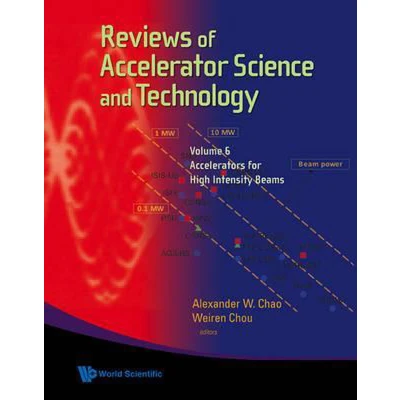
Particle accelerators are a major invention of the 20th century. In the last eight decades,they have evolved enormously and have fundamentally changed the way we live, think and work.Accelerators are the most powerful microscopes for viewing the tiniest inner structure of cells, genes, molecules, atoms and their constituents such as protons, neutrons, electrons, neutrinos and quarks. This opens up a whole new world for materials science, chemistry and molecular biology. Accelerators with megawatt beam power may ultimately solve a critical problem faced by our society, namely, the treatment of nuclear waste and the supply of an alternative type of energy.There are also tens of thousands of small accelerators all over the world. They are used every day for medical imaging, cancer therapy, radioisotope production, high-density chip-making, mass spectrometry, cargo x-ray/gamma-ray imaging, detection of explosives and illicit drugs, and weapons. This volume provides a comprehensive review of this driving and fascinating field.The poster (also available in 1118 x 406 mm size) which illustrates the history and development of particle accelerators from 1919 to the future can be purchased separately.
BolThe idea of colliding two particle beams to fully exploit the energy of accelerated particles was first proposed by Rolf Wideroee, who in 1943 applied for a patent on the collider concept and was awarded the patent in 1953. The first three colliders - AdA in Italy, CBX in the US, and VEP-1 in the then Soviet Union - came to operation about 50 years ago in the mid-1960s. A number of other colliders followed.Over the past decades, colliders defined the energy frontier in particle physics. Different types of colliers - proton-proton, proton-antiproton, electron-positron, electron-proton, electron-ion and ion-ion colliders - have played complementary roles in fully mapping out the constituents and forces in the Standard Model (SM). We are now at a point where all predicted SM constituents of matter and forces have been found, and all the latest ones were found at colliders. Colliders also play a critical role in advancing beam physics, accelerator research and technology development. It is timely that RAST Volume 7 is dedicated to Colliders.
 Productspecificaties
| EAN |
|
|---|---|
| Maat |
|
 Prijshistorie
 Prijzen voor het laatst bijgewerkt op:
 Gerelateerde resultaten


