








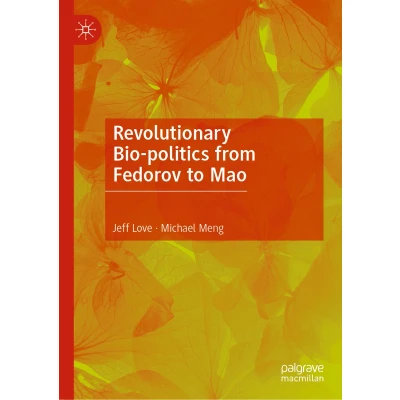
Revolutionary Bio politics from Fedorov to Mao
Uitgelicht

|
115,00 |
Naar shop
|
 Beschrijving
Bol
This book confronts the question of immortality: Is human life without immortality tolerable? This book confronts the question of immortality: Is human life without immortality tolerable? It does so by exploring three attitudes to immortality expressed in the context of three revolutions, the Soviet, the Nazi and the Communist revolution in China. The book begins with an account of the radical Russian tradition of immortalism that culminates in the thought of Nikolai Fedorov (1829-1903), then contrasting this account with the equally radical finitism of Martin Heidegger (1889-1976). Both these strands are then developed in the context of modern Chinese philosophical thinking about technology and the creation of a harmonious relation to nature that reflects in turn a harmonious relation to mortality, one that eschews the radicality of both Fedorov and Heidegger by discerning a “middle way.” This book confronts the question of immortality: Is human life without immortality tolerable? It does so by exploring three attitudes to immortality expressed in the context of three revolutions, the Soviet, the Nazi and the Communist revolution in China. The book begins with an account of the radical Russian tradition of immortalism that culminates in the thought of Nikolai Fedorov (1829-1903), then contrasting this account with the equally radical finitism of Martin Heidegger (1889-1976). Both these strands are then developed in the context of modern Chinese philosophical thinking about technology and the creation of a harmonious relation to nature that reflects in turn a harmonious relation to mortality, one that eschews the radicality of both Fedorov and Heidegger by discerning a “middle way.”


Vergelijk aanbieders (1)

 Beschrijving
(1)
Beschrijving
(1)
This book confronts the question of immortality: Is human life without immortality tolerable? This book confronts the question of immortality: Is human life without immortality tolerable? It does so by exploring three attitudes to immortality expressed in the context of three revolutions, the Soviet, the Nazi and the Communist revolution in China. The book begins with an account of the radical Russian tradition of immortalism that culminates in the thought of Nikolai Fedorov (1829-1903), then contrasting this account with the equally radical finitism of Martin Heidegger (1889-1976). Both these strands are then developed in the context of modern Chinese philosophical thinking about technology and the creation of a harmonious relation to nature that reflects in turn a harmonious relation to mortality, one that eschews the radicality of both Fedorov and Heidegger by discerning a “middle way.” This book confronts the question of immortality: Is human life without immortality tolerable? It does so by exploring three attitudes to immortality expressed in the context of three revolutions, the Soviet, the Nazi and the Communist revolution in China. The book begins with an account of the radical Russian tradition of immortalism that culminates in the thought of Nikolai Fedorov (1829-1903), then contrasting this account with the equally radical finitism of Martin Heidegger (1889-1976). Both these strands are then developed in the context of modern Chinese philosophical thinking about technology and the creation of a harmonious relation to nature that reflects in turn a harmonious relation to mortality, one that eschews the radicality of both Fedorov and Heidegger by discerning a “middle way.”
 Productspecificaties
| EAN |
|
|---|---|
| Maat |
|
 Prijshistorie
Prijzen voor het laatst bijgewerkt op:
 Gerelateerde resultaten


