
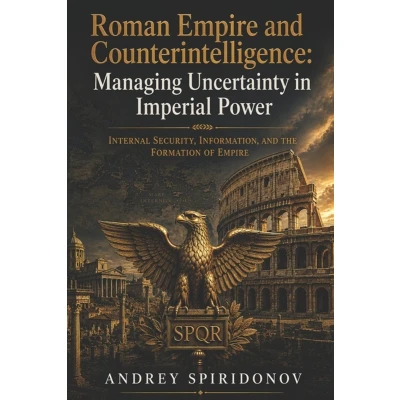
Roman Empire and Counterintelligence: Managing Uncertainty in Imperial Power: Internal Security, Information, the Formation of
Uitgelicht

|
10,08 |
Naar shop
|

|
10,08 |
Naar shop
|

|
11,50 |
Naar shop
|
| VERGELIJK ALLE AANBIEDERS (3) | ||
 Beschrijving
Bol
How do states govern what they cannot fully see?The Roman Empire is often explained through its armies, its laws, and its administrative reach. Yet these elements alone cannot account for its durability. Beneath visible institutions lay a more elusive and decisive problem: how to manage internal uncertainty-how to identify disloyalty, interpret ambiguous signals, and act before threat becomes visible.Roman Empire and Counterintelligence offers a new interpretation of Roman statehood by examining internal security not as episodic repression, but as a structural condition of power. It argues that counterintelligence-understood as the continuous effort to detect, anticipate, and manage internal political threat-was not a marginal feature of Roman governance, but one of its defining logics.Drawing on classical sources, legal texts, and modern analytical frameworks, the book shows how Rome developed a distributed system of internal security embedded in law, institutions, military organization, and political culture. Surveillance, informants, anticipatory law, and the management of fear were not anomalies of imperial excess; they were adaptive responses to the vulnerabilities inherent in governing a vast and heterogeneous empire.The study moves beyond historical reconstruction. It develops a broader theoretical argument about the nature of statehood itself, demonstrating that internal security emerges wherever political systems must operate under conditions of incomplete information and shifting loyalty.The book also introduces Institutional Counterintelligence Analysis (ICA), an original analytical discipline that examines how institutional environments generate distortion, asymmetry, and hidden vulnerability. Applied retrospectively to the Roman case, ICA reveals patterns of power and control that remain relevant to modern systems of governance.This is not a book about repression alone, nor about administrative efficiency in isolation. It is a study of how power operates when certainty is impossible-and how states learn to survive within that condition.


 Beschrijving
(1)
Beschrijving
(1)
How do states govern what they cannot fully see?The Roman Empire is often explained through its armies, its laws, and its administrative reach. Yet these elements alone cannot account for its durability. Beneath visible institutions lay a more elusive and decisive problem: how to manage internal uncertainty-how to identify disloyalty, interpret ambiguous signals, and act before threat becomes visible.Roman Empire and Counterintelligence offers a new interpretation of Roman statehood by examining internal security not as episodic repression, but as a structural condition of power. It argues that counterintelligence-understood as the continuous effort to detect, anticipate, and manage internal political threat-was not a marginal feature of Roman governance, but one of its defining logics.Drawing on classical sources, legal texts, and modern analytical frameworks, the book shows how Rome developed a distributed system of internal security embedded in law, institutions, military organization, and political culture. Surveillance, informants, anticipatory law, and the management of fear were not anomalies of imperial excess; they were adaptive responses to the vulnerabilities inherent in governing a vast and heterogeneous empire.The study moves beyond historical reconstruction. It develops a broader theoretical argument about the nature of statehood itself, demonstrating that internal security emerges wherever political systems must operate under conditions of incomplete information and shifting loyalty.The book also introduces Institutional Counterintelligence Analysis (ICA), an original analytical discipline that examines how institutional environments generate distortion, asymmetry, and hidden vulnerability. Applied retrospectively to the Roman case, ICA reveals patterns of power and control that remain relevant to modern systems of governance.This is not a book about repression alone, nor about administrative efficiency in isolation. It is a study of how power operates when certainty is impossible-and how states learn to survive within that condition.
 Productspecificaties
 Prijshistorie
* Prijshistorie bevat geen data van Amazon, Amazon Marketplace.
Prijzen voor het laatst bijgewerkt op:
 Gerelateerde resultaten


