








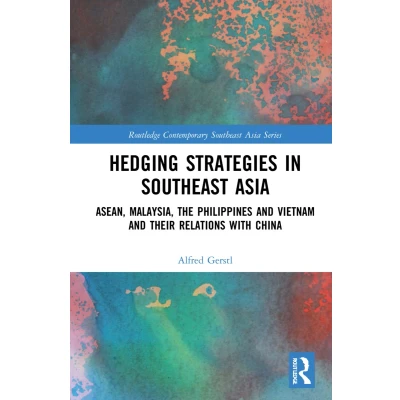
Routledge Contemporary Southeast Asia Series Hedging Strategies in
Uitgelicht

|
48,99 |
Naar shop
|
 Beschrijving
Bol
Introducing a re-conceptualized hedging framework, this book analyses the relations of the Association of Southeast Asian Nations (ASEAN) and the middle powers Malaysia, the Philippines, and Vietnam with China in the context of the Belt and Road Initiative (BRI). Introducing a re-conceptualized comprehensive hedging framework, this book analyses the relations of the Association of Southeast Asian Nations (ASEAN), Malaysia, the Philippines, and Vietnam with China in the context of the Belt and Road Initiative (BRI) and the South China Sea dispute. The author argues that ASEAN and the three Southeast Asian governments pursue a hedging strategy towards the rising China. Hedging expands the strategic options of smaller powers which are in Neorealism often restricted to bandwagoning and balancing. A hedging strategy, however, can simultaneously contain both elements of bandwagoning (e.g., in economics) and balancing (e.g., in security affairs). Even though the four hedging strategies and their implementation vary, in principle they all seek closer economic relations with Beijing, while maintaining strong security relations with Washington. A major innovation of the new hedging concept is the inclusion of the perceptions of the hedger on the risks and opportunities stemming from the relations with the hedging target and of the strategic value of potential hedging partners. The comprehensive hedging concept and the important empirical findings will be of interest to researchers in the fields of International Relations, Security, Political Geography, Economics, History, and Asian Studies.


Vergelijk aanbieders (1)

 Beschrijving
(1)
Beschrijving
(1)
Introducing a re-conceptualized hedging framework, this book analyses the relations of the Association of Southeast Asian Nations (ASEAN) and the middle powers Malaysia, the Philippines, and Vietnam with China in the context of the Belt and Road Initiative (BRI). Introducing a re-conceptualized comprehensive hedging framework, this book analyses the relations of the Association of Southeast Asian Nations (ASEAN), Malaysia, the Philippines, and Vietnam with China in the context of the Belt and Road Initiative (BRI) and the South China Sea dispute. The author argues that ASEAN and the three Southeast Asian governments pursue a hedging strategy towards the rising China. Hedging expands the strategic options of smaller powers which are in Neorealism often restricted to bandwagoning and balancing. A hedging strategy, however, can simultaneously contain both elements of bandwagoning (e.g., in economics) and balancing (e.g., in security affairs). Even though the four hedging strategies and their implementation vary, in principle they all seek closer economic relations with Beijing, while maintaining strong security relations with Washington. A major innovation of the new hedging concept is the inclusion of the perceptions of the hedger on the risks and opportunities stemming from the relations with the hedging target and of the strategic value of potential hedging partners. The comprehensive hedging concept and the important empirical findings will be of interest to researchers in the fields of International Relations, Security, Political Geography, Economics, History, and Asian Studies.
 Productspecificaties
| EAN |
|
|---|---|
| Maat |
|
 Prijshistorie
Prijzen voor het laatst bijgewerkt op:
 Gerelateerde resultaten


