
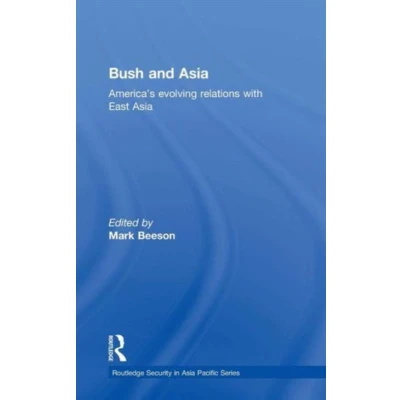
Routledge Security in Asia Pacific Series Bush and
Uitgelicht

|
43,99 |
Naar shop
|
| VERGELIJK ALLE AANBIEDERS (1) | ||
 Beschrijving
Bol
Bush and Asia analyzes the changing nature of relations between the East Asian nations and the United States since the election of George W. Bush in 2000 and the events of September 11, 2001. The United States is now the most powerful nation in history, and this power has grown since September 11, 2001, forcing nations around the globe to re-evaluate their relationships to the unipolar superpower. Nowhere is this re-evaluation more important than in East Asia, a region that has been defined by American power since the Second World War. Indeed, despite America’s physical distance from East Asia, the United States has been a key player in the region since the nineteenth century, when it played a major role in opening up both Japan and China to the West. This book details the changing nature of power relations in East Asia, and includes case studies on China, Japan, Thailand, the Philippines, Indonesia, Malaysia, Korea and Australia. It argues that there are a number of insights that can be drawn from various traditions which help to explain the complex, multi-dimensional nature of American power at the beginning of the twenty-first century. Across the region, countries are being forced to come to terms with and accommodate America’s dominant position and its increasingly assertive foreign policy. History and contingent contemporary circumstances mean that the precise nature of bilateral relationships will be different. But whether the Bush Doctrine is having a salutary or destructive effect on the region or specific countries, it is something East Asia and the rest of the world will have to learn to live with.


Vergelijk aanbieders (1)

 Beschrijving
(1)
Beschrijving
(1)
Bush and Asia analyzes the changing nature of relations between the East Asian nations and the United States since the election of George W. Bush in 2000 and the events of September 11, 2001. The United States is now the most powerful nation in history, and this power has grown since September 11, 2001, forcing nations around the globe to re-evaluate their relationships to the unipolar superpower. Nowhere is this re-evaluation more important than in East Asia, a region that has been defined by American power since the Second World War. Indeed, despite America’s physical distance from East Asia, the United States has been a key player in the region since the nineteenth century, when it played a major role in opening up both Japan and China to the West. This book details the changing nature of power relations in East Asia, and includes case studies on China, Japan, Thailand, the Philippines, Indonesia, Malaysia, Korea and Australia. It argues that there are a number of insights that can be drawn from various traditions which help to explain the complex, multi-dimensional nature of American power at the beginning of the twenty-first century. Across the region, countries are being forced to come to terms with and accommodate America’s dominant position and its increasingly assertive foreign policy. History and contingent contemporary circumstances mean that the precise nature of bilateral relationships will be different. But whether the Bush Doctrine is having a salutary or destructive effect on the region or specific countries, it is something East Asia and the rest of the world will have to learn to live with.
 Productspecificaties
| EAN |
|
|---|---|
| Maat |
|
 Prijshistorie
Prijzen voor het laatst bijgewerkt op:
 Gerelateerde resultaten


