
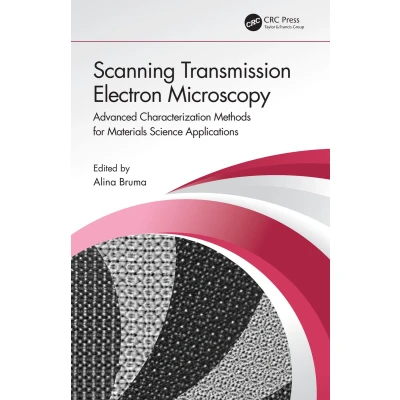
Scanning Transmission Electron Microscopy
Uitgelicht

|
153,00 |
Naar shop
|
| VERGELIJK ALLE AANBIEDERS (1) | ||
 Beschrijving
Bol
This book focuses on explaining and applying the principles of machine learning-based techniques and advanced image processing methods currently used in the electron microscopy community suitable for handling large electron microscopy data sets and extracting structure-property information for various materials. Scanning Transmission Electron Microscopy is focused on discussing the latest approaches in the recording of high-fidelity quantitative annular dark-field (ADF) data. It showcases the application of machine learning in electron microscopy and the latest advancements in image processing and data interpretation for materials notoriously difficult to analyze using scanning transmission electron microscopy (STEM). It also highlights strategies to record and interpret large electron diffraction datasets for the analysis of nanostructures. This book: Discusses existing approaches for experimental design in the recording of high-fidelity quantitative ADF data Presents the most common types of scintillator-photomultiplier ADF detectors, along with their strengths and weaknesses. Proposes strategies to minimize the introduction of errors from these detectors and avenues for dealing with residual errors Discusses the practice of reliable multiframe imaging, along with the benefits and new experimental opportunities it presents in electron dose or dose-rate management Focuses on supervised and unsupervised machine learning for electron microscopy Discusses open data formats, community-driven software, and data repositories Proposes methods to process information at both global and local scales, and discusses avenues to improve the storage, transfer, analysis, and interpretation of multidimensional datasets Provides the spectrum of possibilities to study materials at the resolution limit by means of new developments in instrumentation Recommends methods for quantitative structural characterization of sensitive nanomaterials using electron diffraction techniques and describes strategies to collect electron diffraction patterns for such materials This book helps academics, researchers, and industry professionals in materials science, chemistry, physics, and related fields to understand and apply computer-science–derived analysis methods to solve problems regarding data analysis and interpretation of materials properties.


Vergelijk aanbieders (1)

 Beschrijving
(1)
Beschrijving
(1)
This book focuses on explaining and applying the principles of machine learning-based techniques and advanced image processing methods currently used in the electron microscopy community suitable for handling large electron microscopy data sets and extracting structure-property information for various materials. Scanning Transmission Electron Microscopy is focused on discussing the latest approaches in the recording of high-fidelity quantitative annular dark-field (ADF) data. It showcases the application of machine learning in electron microscopy and the latest advancements in image processing and data interpretation for materials notoriously difficult to analyze using scanning transmission electron microscopy (STEM). It also highlights strategies to record and interpret large electron diffraction datasets for the analysis of nanostructures. This book: Discusses existing approaches for experimental design in the recording of high-fidelity quantitative ADF data Presents the most common types of scintillator-photomultiplier ADF detectors, along with their strengths and weaknesses. Proposes strategies to minimize the introduction of errors from these detectors and avenues for dealing with residual errors Discusses the practice of reliable multiframe imaging, along with the benefits and new experimental opportunities it presents in electron dose or dose-rate management Focuses on supervised and unsupervised machine learning for electron microscopy Discusses open data formats, community-driven software, and data repositories Proposes methods to process information at both global and local scales, and discusses avenues to improve the storage, transfer, analysis, and interpretation of multidimensional datasets Provides the spectrum of possibilities to study materials at the resolution limit by means of new developments in instrumentation Recommends methods for quantitative structural characterization of sensitive nanomaterials using electron diffraction techniques and describes strategies to collect electron diffraction patterns for such materials This book helps academics, researchers, and industry professionals in materials science, chemistry, physics, and related fields to understand and apply computer-science–derived analysis methods to solve problems regarding data analysis and interpretation of materials properties.
 Productspecificaties
| EAN |
|
|---|---|
| Maat |
|
 Prijshistorie
Prijzen voor het laatst bijgewerkt op:
 Gerelateerde resultaten


