
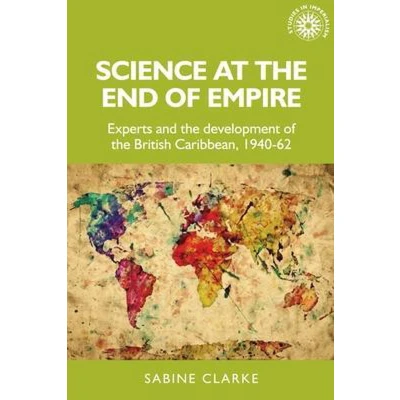
Science at the end of empire Experts and development British Caribbean, 194062 Studies in Imperialism
Uitgelicht

|
34,80 |
Naar shop
|
| VERGELIJK ALLE AANBIEDERS (1) | ||
 Beschrijving
Bol
One solution to West Indian problems after 1940 was to transform sugarcane into a raw material for making synthetics. Britain hoped to encourage new industry by providing scientific information that business might exploit. This plan was threatened by American promotion of a different model of development. This is the first exploration of Britain’s plans for industrial development in its Caribbean colonies. Historians have often denied that Britain ever had such hopes, but this book shows that, following revelations of serious deprivation during the 1930s, the Colonial Office launched a scheme to revitalise the region by using cane sugar as the raw material for making fuels, plastics and drugs. This volume shows the practical and political importance of scientific research and expert advice for the creation and implementation of Britain's colonial development plans after 1940.Laboratory research into finding industrial uses for sugar offered a means for the Colonial Office to intervene in the development of the Caribbean with minimal disturbance to market forces. Once knowledge had been produced, decisions about the commercial production of sugar-based compounds could be left to business. This vision of industrial development rejected state planning and control, and was far more liberal in character than the large, rational and highly regimented schemes that were often promoted for colonial Africa. Colonial Office attempts to persuade the colonies to take up its preferred route to industrialisation were made difficult however, by the growing autonomy of Caribbean governments as they approached independence. Additionally, American experts attached to the Caribbean Commission offered an alternative model of industrial development, based on the work of Puerto Rico’s development corporation. This book illustrates the competition between Britain and America to shape the future of the Caribbean region, in which the provision of information and expert advice assumed a crucial role. It brings to light forgotten ideas of sugar as an industrial raw material, and shows the importance of science in the colonies in the post-war period. This is the first account of Britain’s plans for industrial development in its Caribbean colonies – something that historians have usually said Britain never contemplated. It shows that Britain’s remedy to the poor economic conditions in the Caribbean gave a key role to laboratory research to re-invent sugarcane as the raw material for making fuels, plastics and drugs. Science at the end of empire explores the practical and also political functions of scientific research and economic advisors for Britain at a moment in which Caribbean governments operated with increasing autonomy and the US was intent on expanding its influence in the region. Britain’s preferred path to industrial development was threatened by an alternative promoted through the Caribbean Commission. The provision of knowledge and expertise became key routes by which Britain and America competed to shape the future of the region, and their place in it.An electronic edition of this book is freely available under a Creative Commons (CC BY) licence.


Vergelijk aanbieders (1)

 Beschrijving
(1)
Beschrijving
(1)
One solution to West Indian problems after 1940 was to transform sugarcane into a raw material for making synthetics. Britain hoped to encourage new industry by providing scientific information that business might exploit. This plan was threatened by American promotion of a different model of development. This is the first exploration of Britain’s plans for industrial development in its Caribbean colonies. Historians have often denied that Britain ever had such hopes, but this book shows that, following revelations of serious deprivation during the 1930s, the Colonial Office launched a scheme to revitalise the region by using cane sugar as the raw material for making fuels, plastics and drugs. This volume shows the practical and political importance of scientific research and expert advice for the creation and implementation of Britain's colonial development plans after 1940.Laboratory research into finding industrial uses for sugar offered a means for the Colonial Office to intervene in the development of the Caribbean with minimal disturbance to market forces. Once knowledge had been produced, decisions about the commercial production of sugar-based compounds could be left to business. This vision of industrial development rejected state planning and control, and was far more liberal in character than the large, rational and highly regimented schemes that were often promoted for colonial Africa. Colonial Office attempts to persuade the colonies to take up its preferred route to industrialisation were made difficult however, by the growing autonomy of Caribbean governments as they approached independence. Additionally, American experts attached to the Caribbean Commission offered an alternative model of industrial development, based on the work of Puerto Rico’s development corporation. This book illustrates the competition between Britain and America to shape the future of the Caribbean region, in which the provision of information and expert advice assumed a crucial role. It brings to light forgotten ideas of sugar as an industrial raw material, and shows the importance of science in the colonies in the post-war period. This is the first account of Britain’s plans for industrial development in its Caribbean colonies – something that historians have usually said Britain never contemplated. It shows that Britain’s remedy to the poor economic conditions in the Caribbean gave a key role to laboratory research to re-invent sugarcane as the raw material for making fuels, plastics and drugs. Science at the end of empire explores the practical and also political functions of scientific research and economic advisors for Britain at a moment in which Caribbean governments operated with increasing autonomy and the US was intent on expanding its influence in the region. Britain’s preferred path to industrial development was threatened by an alternative promoted through the Caribbean Commission. The provision of knowledge and expertise became key routes by which Britain and America competed to shape the future of the region, and their place in it.An electronic edition of this book is freely available under a Creative Commons (CC BY) licence.
 Productspecificaties
| EAN |
|
|---|---|
| Maat |
|
 Prijshistorie
Prijzen voor het laatst bijgewerkt op:
 Gerelateerde resultaten


