

€ 27,83 Gratis verzending

Gesponsorde links
|
|
27,83 |
Naar shop
|

|
27,83 |
Naar shop
|

|
28,39 |
Naar shop
|
| VERGELIJK ALLE AANBIEDERS (3) | ||
 Beschrijving
Vergelijk aanbieders (3)
Gesponsorde links · Sommige shops betalen ons een vergoeding
€ 27,83 Gratis verzending
€ 27,83 Gratis verzending
€ 28,39 Gratis verzending
Winkels met andere maten
Beschrijving
(1)
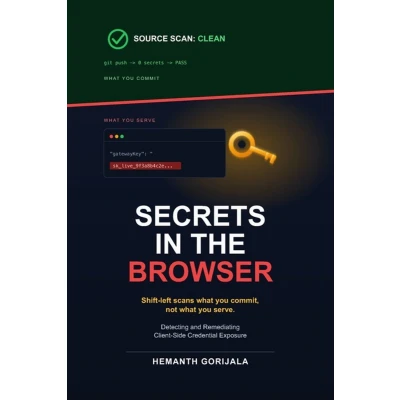
Modern security programs scan repositories, pull requests, and pipelines for secrets. Those controls are necessary, but they answer only one question: is the source clean. They do not prove what the deployed application actually serves to a browser after it is built, configured, and running. Single-page applications, cloud-backed front ends, API gateways, runtime configuration, and source maps create paths where a credential appears only after source review. A build step can inline a secret into a JavaScript bundle. A runtime endpoint can serve it live. A source map can reveal it. In each case the repository is clean and the served application is not. Secrets in the Browser is a practitioner field guide to that gap. You will learn the five structural paths that deliver credentials to clients; why DAST scanners crawl the right files but do not classify credential-grade values inside JavaScript, JSON, XML, source maps, and API responses; how to inspect live traffic and classify public identifiers versus credential-grade values; step-by-step remediation using PKCE, the backend-for-frontend pattern, API gateways, managed identity, vaults, and CI/CD release gates; and how to scan source, build artifacts, and runtime. Written for application-security engineers, penetration testers, DevSecOps and platform engineers, frontend and full-stack developers, and the engineering leaders who set release standards. All examples are synthetic.
 Prijshistorie
* Prijshistorie bevat geen data van Amazon, Amazon Marketplace.
Prijzen voor het laatst bijgewerkt op:
 Gerelateerde resultaten
 Productspecificaties


