
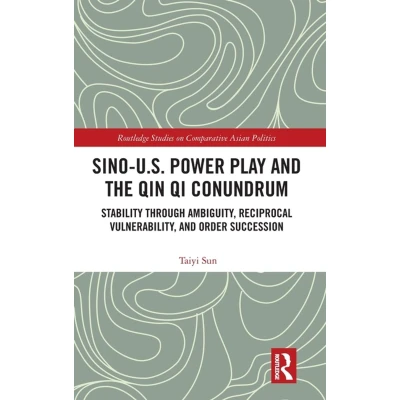
Sino-U.S. Power Play and the Qin Qi Conundrum: Stability through Ambiguity, Reciprocal Vulnerability, Order Succession
Uitgelicht

|
171,25
169,00 |
Naar shop
|

|
222,60 |
Naar shop
|

|
222,60 |
Naar shop
|
| VERGELIJK ALLE AANBIEDERS (3) | ||
 Beschrijving
Bol
Challenging the Thucydides Trap and Power Transition Theory, the book argues that war between China and the United States is not structurally inevitable. Instead, their relationship has been shaped—and often stabilized—by shifting mechanisms across different phases of power transition. This book combines process tracing with original quantitative and qualitative analysis of U.S. and Chinese official discourse, legislation, and elite perspectives in order to trace the key turning points in Sino–U.S. relations since the 1970s. Challenging the Thucydides Trap and Power Transition Theory, the book argues that war between China and the United States is not structurally inevitable. Instead, their relationship has been shaped—and often stabilized—by shifting mechanisms across different phases of power transition. It identifies three core stabilizers: Stability through Ambiguity, where uncertainty about intentions and capabilities delays containment; Mutually Assured Economic Destruction (MAED) / Reciprocal Vulnerability Interdependence (RVI), where asymmetric interdependence creates credible deterrence; and Order-Succession Rise, where a rising power inherits and adapts—rather than overturns—the existing order, as the status quo power seeks alternatives. By integrating historical comparison with rigorous empirical evidence, it offers a theoretically innovative and globally generalizable account of power transition—one that explains how sustained stability is possible even amid intensifying great power competition. This book will appeal to students and scholars of Chinese politics, US politics, comparative politics, and international relations.


 Beschrijving
(1)
Beschrijving
(1)
Challenging the Thucydides Trap and Power Transition Theory, the book argues that war between China and the United States is not structurally inevitable. Instead, their relationship has been shaped—and often stabilized—by shifting mechanisms across different phases of power transition. This book combines process tracing with original quantitative and qualitative analysis of U.S. and Chinese official discourse, legislation, and elite perspectives in order to trace the key turning points in Sino–U.S. relations since the 1970s. Challenging the Thucydides Trap and Power Transition Theory, the book argues that war between China and the United States is not structurally inevitable. Instead, their relationship has been shaped—and often stabilized—by shifting mechanisms across different phases of power transition. It identifies three core stabilizers: Stability through Ambiguity, where uncertainty about intentions and capabilities delays containment; Mutually Assured Economic Destruction (MAED) / Reciprocal Vulnerability Interdependence (RVI), where asymmetric interdependence creates credible deterrence; and Order-Succession Rise, where a rising power inherits and adapts—rather than overturns—the existing order, as the status quo power seeks alternatives. By integrating historical comparison with rigorous empirical evidence, it offers a theoretically innovative and globally generalizable account of power transition—one that explains how sustained stability is possible even amid intensifying great power competition. This book will appeal to students and scholars of Chinese politics, US politics, comparative politics, and international relations.
 Productspecificaties
 Prijshistorie
* Prijshistorie bevat geen data van Amazon, Amazon Marketplace.
Prijzen voor het laatst bijgewerkt op:
 Gerelateerde resultaten


