


€ 52,99 Gratis verzending

Uitgelicht
|
|
52,99 |
Naar shop
|

|
55,45 |
Naar shop
|

|
55,45 |
Naar shop
|
| VERGELIJK ALLE AANBIEDERS (3) | ||
 Beschrijving
Vergelijk aanbieders (3)
€ 52,99 Gratis verzending
€ 55,45 Gratis verzending
€ 55,45 Gratis verzending
Winkels met andere maten
Beschrijving
(1)
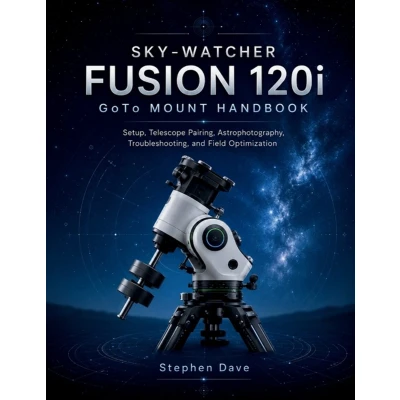
A computerized mount becomes dependable when its mechanics, balance, power, alignment, control method, telescope load, and cable movement are treated as one system. This handbook helps owners move beyond the minimum startup sequence and understand why pointing accuracy, tracking, stability, connectivity, clearance, and imaging performance change from one configuration to another. The opening chapters examine mount architecture, driven axes, clutches, saddle engagement, payload interpretation, center of gravity, tube length, accessory position, tripod geometry, vibration, wind, and collision clearance. Readers learn why a published payload number cannot determine suitability by itself and how to evaluate a telescope combination before the motors are powered. Step-by-step operating coverage develops tripod and head assembly, internal and external power, charging, conservative field-power planning, cable routing, handset control, wireless connections, mobile operation, computer links, firmware awareness, alignment preparation, centering technique, pointing models, object acquisition, and tracking. The emphasis is on repeatable habits that make each session easier to diagnose and reproduce. Application chapters match the mount to refractors, reflectors, compact optical tubes, long tubes, visual accessories, and camera configurations. Readers explore high-magnification observing, lunar and planetary capture, electronically assisted observing, short exposures, optional wedge operation, guiding, longer exposures, computer control, and third-party integration while maintaining realistic expectations about stability, balance, rotation, and exposure length. Troubleshooting separates mechanical, power, alignment, wireless, controller, motor, tracking, clearance, imaging, and software symptoms. Performance benchmarking helps distinguish normal limits from degradation, while configuration profiles, session logs, decision trees, worksheets, quick references, and field checklists turn successful settings into repeatable practice. Use this independent guide to choose compatible loads, assemble safely, improve pointing, protect cables, select an appropriate control path, plan realistic imaging, and recover logically when the mount behaves unexpectedly. It also helps owners record successful configurations for faster setup on later nights. Always verify current official requirements before firmware updates, electrical changes, repairs, or decisions that may affect equipment safety or warranty coverage.- Evaluate payload, balance, tube length, stability, and clearance- Build repeatable power, cable, controller, and wireless workflows- Improve alignment, object acquisition, and tracking precision- Plan visual, planetary, assisted, short-exposure, and wedge sessions- Diagnose mechanical, electrical, connection, and software problems
 Prijshistorie
 * Prijshistorie bevat geen data van Amazon, Amazon Marketplace.
Prijzen voor het laatst bijgewerkt op:
 Gerelateerde resultaten
 Productspecificaties


