
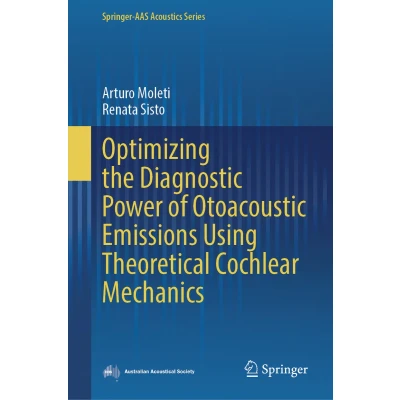
Springer AAS Acoustics Series Optimizing the Diagnostic Power of Otoacoustic Emissions Using Theoretical Cochlear Mechanics
Uitgelicht

|
145,00 |
Naar shop
|
| VERGELIJK ALLE AANBIEDERS (1) | ||
 Beschrijving
Bol
This book examines the diagnostic usefulness of otoacoustic emissions (OAEs) in the context of theoretical cochlear mechanics. This book examines the diagnostic usefulness of otoacoustic emissions (OAEs) in the context of theoretical cochlear mechanics. OAEs have proven to be immensely useful for diagnostic purposes. The phenomenology of hearing physiology, and OAEs in particular, is briefly summarized, providing the necessary references to the literature. State-of-the-art linear and nonlinear mathematical models of the cochlea are discussed, using fundamental concepts of fluid dynamics and mechanics of vibrating systems, often exploiting the formal analogy between mechanical and electric linear systems. In particular, it is explained how the theoretical predictions about the OAE level, phase, and nonlinear I/O functions allow one to design advanced acquisition and analysis tools that significantly improve the specificity and sensitivity of OAEs to hearing dysfunction and other important physiological effects. Examples of diagnostic applications of OAEs in audiology, neurology, and space physiology are discussed, with all of the information needed to develop an OAE experiment provided, from instrument and acquisition setup to signal analysis and theoretical interpretation. The book is targeted at graduate students and researchers in hearing science with at least a basic knowledge of classical physics, calculus, Fourier analysis and signal analysis. This book examines the diagnostic usefulness of otoacoustic emissions (OAEs) in the context of theoretical cochlear mechanics. OAEs have proven to be immensely useful for diagnostic purposes. The phenomenology of hearing physiology, and OAEs in particular, is briefly summarized, providing the necessary references to the literature. State-of-the-art linear and nonlinear mathematical models of the cochlea are discussed, using fundamental concepts of fluid dynamics and mechanics of vibrating systems, often exploiting the formal analogy between mechanical and electric linear systems. In particular, it is explained how the theoretical predictions about the OAE level, phase, and nonlinear I/O functions allow one to design advanced acquisition and analysis tools that significantly improve the specificity and sensitivity of OAEs to hearing dysfunction and other important physiological effects. Examples of diagnostic applications of OAEs in audiology, neurology, and space physiology are discussed, with all of the information needed to develop an OAE experiment provided, from instrument and acquisition setup to signal analysis and theoretical interpretation. The book is targeted at graduate students and researchers in hearing science with at least a basic knowledge of classical physics, calculus, Fourier analysis and signal analysis.


Vergelijk aanbieders (1)

 Beschrijving
(1)
Beschrijving
(1)
This book examines the diagnostic usefulness of otoacoustic emissions (OAEs) in the context of theoretical cochlear mechanics. This book examines the diagnostic usefulness of otoacoustic emissions (OAEs) in the context of theoretical cochlear mechanics. OAEs have proven to be immensely useful for diagnostic purposes. The phenomenology of hearing physiology, and OAEs in particular, is briefly summarized, providing the necessary references to the literature. State-of-the-art linear and nonlinear mathematical models of the cochlea are discussed, using fundamental concepts of fluid dynamics and mechanics of vibrating systems, often exploiting the formal analogy between mechanical and electric linear systems. In particular, it is explained how the theoretical predictions about the OAE level, phase, and nonlinear I/O functions allow one to design advanced acquisition and analysis tools that significantly improve the specificity and sensitivity of OAEs to hearing dysfunction and other important physiological effects. Examples of diagnostic applications of OAEs in audiology, neurology, and space physiology are discussed, with all of the information needed to develop an OAE experiment provided, from instrument and acquisition setup to signal analysis and theoretical interpretation. The book is targeted at graduate students and researchers in hearing science with at least a basic knowledge of classical physics, calculus, Fourier analysis and signal analysis. This book examines the diagnostic usefulness of otoacoustic emissions (OAEs) in the context of theoretical cochlear mechanics. OAEs have proven to be immensely useful for diagnostic purposes. The phenomenology of hearing physiology, and OAEs in particular, is briefly summarized, providing the necessary references to the literature. State-of-the-art linear and nonlinear mathematical models of the cochlea are discussed, using fundamental concepts of fluid dynamics and mechanics of vibrating systems, often exploiting the formal analogy between mechanical and electric linear systems. In particular, it is explained how the theoretical predictions about the OAE level, phase, and nonlinear I/O functions allow one to design advanced acquisition and analysis tools that significantly improve the specificity and sensitivity of OAEs to hearing dysfunction and other important physiological effects. Examples of diagnostic applications of OAEs in audiology, neurology, and space physiology are discussed, with all of the information needed to develop an OAE experiment provided, from instrument and acquisition setup to signal analysis and theoretical interpretation. The book is targeted at graduate students and researchers in hearing science with at least a basic knowledge of classical physics, calculus, Fourier analysis and signal analysis.
 Productspecificaties
| EAN |
|
|---|---|
| Maat |
|
 Prijshistorie
Prijzen voor het laatst bijgewerkt op:
 Gerelateerde resultaten


