
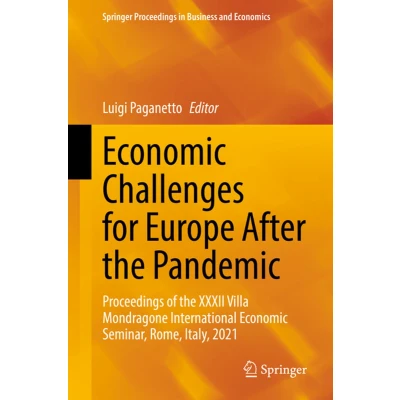
Springer Proceedings in Business and Economics Economic Challenges for Europe After the Pandemic
Uitgelicht

|
149,00 |
Naar shop
|
| VERGELIJK ALLE AANBIEDERS (1) | ||
 Beschrijving
Bol
This book focuses on the recovery and new normal in a post-Covid scenario, drawing important lessons from the pandemic and proposing new ideas for sustainable development, endogenous dynamism, and inclusive growth. This book focuses on the recovery and new normal in a post-Covid scenario, drawing important lessons from the pandemic and proposing new ideas for sustainable development, endogenous dynamism, and inclusive growth. The book presents different ideas and perspectives about the present and the future, reflecting on four main fields of our economic reality: macroeconomics, governments, technology, and society. It discusses important topics for future economic scenarios, beginning with an estimation of the economic consequences of the absence of an equitable distribution of vaccines. Further topics discussed include the government’s debts sustainability, the probability of an inflation/deflation or of a stagflation scenario, as well as the impact of US and European economic policies on economic growth. The book further investigates the economic costs of the pandemic, which have fallen most heavily on those least able to bear them. It examines governments subsidies, which supported people and firms through wage subsidies, unemployment benefits, and other fiscal measures, and discusses the question of whether more investment in health care, education, and other public services will still be needed. In a time of immense change and global challenges, this book is a must-read for scholars, researchers, and students of economics, as well as policy-makers interested in a better understanding of economic growth, energy, environment, migration, development, digital transformation, and demography. This book focuses on the recovery and new normal in a post-Covid scenario, drawing important lessons from the pandemic and proposing new ideas for sustainable development, endogenous dynamism, and inclusive growth. The book presents different ideas and perspectives about the present and the future, reflecting on four main fields of our economic reality: macroeconomics, governments, technology, and society. It discusses important topics for future economic scenarios, beginning with an estimation of the economic consequences of the absence of an equitable distribution of vaccines. Further topics discussed include the government’s debts sustainability, the probability of an inflation/deflation or of a stagflation scenario, as well as the impact of US and European economic policies on economic growth. The book further investigates the economic costs of the pandemic, which have fallen most heavily on those least able to bear them. It examines governments subsidies, which supported people and firms through wage subsidies, unemployment benefits, and other fiscal measures, and discusses the question of whether more investment in health care, education, and other public services will still be needed. In a time of immense change and global challenges, this book is a must-read for scholars, researchers, and students of economics, as well as policy-makers interested in a better understanding of economic growth, energy, environment, migration, development, digital transformation, and demography.


Vergelijk aanbieders (1)

 Beschrijving
(1)
Beschrijving
(1)
This book focuses on the recovery and new normal in a post-Covid scenario, drawing important lessons from the pandemic and proposing new ideas for sustainable development, endogenous dynamism, and inclusive growth. This book focuses on the recovery and new normal in a post-Covid scenario, drawing important lessons from the pandemic and proposing new ideas for sustainable development, endogenous dynamism, and inclusive growth. The book presents different ideas and perspectives about the present and the future, reflecting on four main fields of our economic reality: macroeconomics, governments, technology, and society. It discusses important topics for future economic scenarios, beginning with an estimation of the economic consequences of the absence of an equitable distribution of vaccines. Further topics discussed include the government’s debts sustainability, the probability of an inflation/deflation or of a stagflation scenario, as well as the impact of US and European economic policies on economic growth. The book further investigates the economic costs of the pandemic, which have fallen most heavily on those least able to bear them. It examines governments subsidies, which supported people and firms through wage subsidies, unemployment benefits, and other fiscal measures, and discusses the question of whether more investment in health care, education, and other public services will still be needed. In a time of immense change and global challenges, this book is a must-read for scholars, researchers, and students of economics, as well as policy-makers interested in a better understanding of economic growth, energy, environment, migration, development, digital transformation, and demography. This book focuses on the recovery and new normal in a post-Covid scenario, drawing important lessons from the pandemic and proposing new ideas for sustainable development, endogenous dynamism, and inclusive growth. The book presents different ideas and perspectives about the present and the future, reflecting on four main fields of our economic reality: macroeconomics, governments, technology, and society. It discusses important topics for future economic scenarios, beginning with an estimation of the economic consequences of the absence of an equitable distribution of vaccines. Further topics discussed include the government’s debts sustainability, the probability of an inflation/deflation or of a stagflation scenario, as well as the impact of US and European economic policies on economic growth. The book further investigates the economic costs of the pandemic, which have fallen most heavily on those least able to bear them. It examines governments subsidies, which supported people and firms through wage subsidies, unemployment benefits, and other fiscal measures, and discusses the question of whether more investment in health care, education, and other public services will still be needed. In a time of immense change and global challenges, this book is a must-read for scholars, researchers, and students of economics, as well as policy-makers interested in a better understanding of economic growth, energy, environment, migration, development, digital transformation, and demography.
 Productspecificaties
| EAN |
|
|---|---|
| Maat |
|
 Prijshistorie
Prijzen voor het laatst bijgewerkt op:
 Gerelateerde resultaten


