
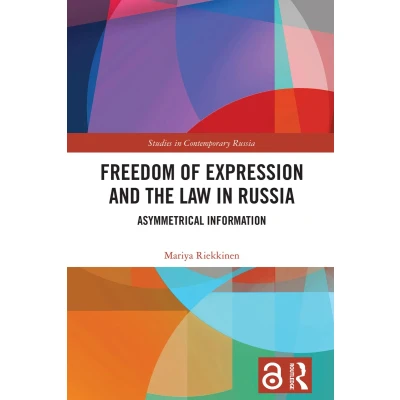
Studies in Contemporary Russia Freedom of Expression and the Law
Uitgelicht

|
60,99 |
Naar shop
|

|
84,80 |
Naar shop
|
| VERGELIJK ALLE AANBIEDERS (2) | ||
 Beschrijving
Bol
This book discusses how Russia's legal system restricts freedom of expression. This book discusses how Russia’s legal system restricts freedom of expression. As the author analyses legal amendments restricting the free flow of information since 2012, she draws upon Akerlof’s framework of “Asymmetrical information” and Luhmann’s “System Theory” to show how these amendments have deprived citizens of the opportunity to voice criticisms, influence public affairs, or take collective action against decision-makers. Among the innovations are the establishment of a “President Emeritus” institution and the introduction of laws through legislative processes already on hold – something we call “legislation through winter preservatives.” The author provides a nuanced understanding of these and other processes that limit the free flow of information while simultaneously exploring the reasons why Russia’s regime still endures. The volume will be of interest to scholars and students of law, political science, international law, area studies, development studies, peace research, comparative politics/comparative area studies, citizenship studies, communication studies, social movements, and international organisations. Experts working with Russia in international organisations and the media will also find this systematic analysis of the transformation of Russian legislation and its consequences invaluable. The Open Access version of this book, available at , has been made available under a Creative Commons Attribution-Non-Commercial (CC-BY-NC) 4.0 license. Open Access has been funded by Åbo Akademi University.


 Beschrijving
(1)
Beschrijving
(1)
This book discusses how Russia's legal system restricts freedom of expression. This book discusses how Russia’s legal system restricts freedom of expression. As the author analyses legal amendments restricting the free flow of information since 2012, she draws upon Akerlof’s framework of “Asymmetrical information” and Luhmann’s “System Theory” to show how these amendments have deprived citizens of the opportunity to voice criticisms, influence public affairs, or take collective action against decision-makers. Among the innovations are the establishment of a “President Emeritus” institution and the introduction of laws through legislative processes already on hold – something we call “legislation through winter preservatives.” The author provides a nuanced understanding of these and other processes that limit the free flow of information while simultaneously exploring the reasons why Russia’s regime still endures. The volume will be of interest to scholars and students of law, political science, international law, area studies, development studies, peace research, comparative politics/comparative area studies, citizenship studies, communication studies, social movements, and international organisations. Experts working with Russia in international organisations and the media will also find this systematic analysis of the transformation of Russian legislation and its consequences invaluable. The Open Access version of this book, available at , has been made available under a Creative Commons Attribution-Non-Commercial (CC-BY-NC) 4.0 license. Open Access has been funded by Åbo Akademi University.
 Productspecificaties
 Prijshistorie
* Prijshistorie bevat geen data van Amazon.
Prijzen voor het laatst bijgewerkt op:
 Gerelateerde resultaten


