








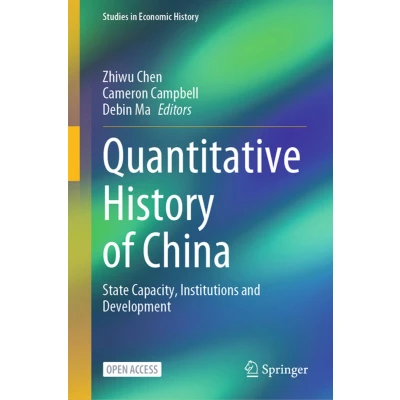
Studies in Economic History Quantitative of China
Uitgelicht

|
50,99 |
Naar shop
|

|
53,49 |
Naar shop
|

|
53,49 |
Naar shop
|
 Beschrijving
Bol
This Open Access book marks the beginning of a new era in the study of Chinese history. Since the beginning of the computer age, quantitative techniques have been increasingly used to study specific topics like family, population, and living standards in China's past. However, sample sizes have usually been small due to either historical archives' availability constraints or limited human processing capacity. With much increased computing power and machine-assisted reading/processing capacity, many big historical databases have become available, offering quantitative historians and social scientists great opportunities to study China's past development experience. This volume showcases a collection of new findings concerning China's political, social, and economic history and typically based on newly constructed large historical datasets. Most of the work has involved an interdisciplinary team of economists, sociologists, political scientists, historians and econometricians, demonstrating how new big data and quantitative methods may be brought to bear on some of the biggest questions related to China's development over the past three millennia and on the implications of distant past events on contemporary China. Topics covered range from the roles of war, state formation, religion, culture, finance and institutions in long-run development and technological innovations, to regicide history, to the organization and capacity of the bureaucracy. Contributors include leading figures in the quantitative study of China's long-run socioeconomic and political history. This volume will be of value to anyone with an interest in Chinese economic, political, social and/or institutional history as well as anyone interested in quantitative history more generally. This Open Access book marks the beginning of a new era in the study of Chinese history. Since the beginning of the computer age, quantitative techniques have been increasingly used to study specific topics like family, population, and living standards in China's past. However, sample sizes have usually been small due to either historical archives' availability constraints or limited human processing capacity. With much increased computing power and machine-assisted reading/processing capacity, many big historical databases have become available, offering quantitative historians and social scientists great opportunities to study China's past development experience. This volume showcases a collection of new findings concerning China's political, social, and economic history and typically based on newly constructed large historical datasets. Most of the work has involved an interdisciplinary team of economists, sociologists, political scientists, historians and econometricians, demonstrating how new big data and quantitative methods may be brought to bear on some of the biggest questions related to China's development over the past three millennia and on the implications of distant past events on contemporary China. Topics covered range from the roles of war, state formation, religion, culture, finance and institutions in long-run development and technological innovations, to regicide history, to the organization and capacity of the bureaucracy. Contributors include leading figures in the quantitative study of China's long-run socioeconomic and political history. This volume will be of value to anyone with an interest in Chinese economic, political, social and/or institutional history as well as anyone interested in quantitative history more generally.


 Beschrijving
(1)
Beschrijving
(1)
This Open Access book marks the beginning of a new era in the study of Chinese history. Since the beginning of the computer age, quantitative techniques have been increasingly used to study specific topics like family, population, and living standards in China's past. However, sample sizes have usually been small due to either historical archives' availability constraints or limited human processing capacity. With much increased computing power and machine-assisted reading/processing capacity, many big historical databases have become available, offering quantitative historians and social scientists great opportunities to study China's past development experience. This volume showcases a collection of new findings concerning China's political, social, and economic history and typically based on newly constructed large historical datasets. Most of the work has involved an interdisciplinary team of economists, sociologists, political scientists, historians and econometricians, demonstrating how new big data and quantitative methods may be brought to bear on some of the biggest questions related to China's development over the past three millennia and on the implications of distant past events on contemporary China. Topics covered range from the roles of war, state formation, religion, culture, finance and institutions in long-run development and technological innovations, to regicide history, to the organization and capacity of the bureaucracy. Contributors include leading figures in the quantitative study of China's long-run socioeconomic and political history. This volume will be of value to anyone with an interest in Chinese economic, political, social and/or institutional history as well as anyone interested in quantitative history more generally. This Open Access book marks the beginning of a new era in the study of Chinese history. Since the beginning of the computer age, quantitative techniques have been increasingly used to study specific topics like family, population, and living standards in China's past. However, sample sizes have usually been small due to either historical archives' availability constraints or limited human processing capacity. With much increased computing power and machine-assisted reading/processing capacity, many big historical databases have become available, offering quantitative historians and social scientists great opportunities to study China's past development experience. This volume showcases a collection of new findings concerning China's political, social, and economic history and typically based on newly constructed large historical datasets. Most of the work has involved an interdisciplinary team of economists, sociologists, political scientists, historians and econometricians, demonstrating how new big data and quantitative methods may be brought to bear on some of the biggest questions related to China's development over the past three millennia and on the implications of distant past events on contemporary China. Topics covered range from the roles of war, state formation, religion, culture, finance and institutions in long-run development and technological innovations, to regicide history, to the organization and capacity of the bureaucracy. Contributors include leading figures in the quantitative study of China's long-run socioeconomic and political history. This volume will be of value to anyone with an interest in Chinese economic, political, social and/or institutional history as well as anyone interested in quantitative history more generally.
 Productspecificaties
 Prijshistorie
* Prijshistorie bevat geen data van Amazon, Amazon Marketplace.
Prijzen voor het laatst bijgewerkt op:
 Gerelateerde resultaten


