








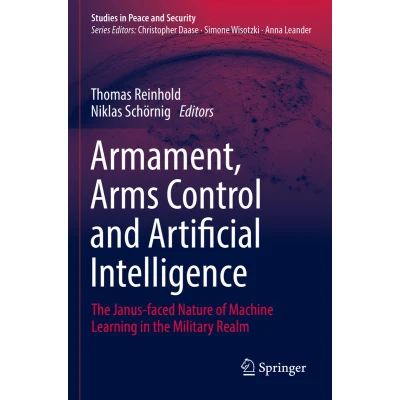
Studies in Peace and Security Armament, Arms Control Artificial Intelligence
Uitgelicht

|
115,00 |
Naar shop
|
 Beschrijving
Bol
Looking at a variety of armament sectors, the book examines how Artificial Intelligence (AI) impacts the fields of armament and arms control, how existing arms control measures will be affected by AI, and what new approaches based on AI have been or are currently developed. Looking at a variety of armament sectors, the book examines how Artificial Intelligence (AI) impacts the fields of armament and arms control, how existing arms control measures will be affected by AI, and what new approaches based on AI have been or are currently developed. The significant increase in computing power, the increasing reliance on software, and the advent of (narrow) AI and deep-learning algorithms all have the potential to lead to disruptive changes for military operations and warfare, rendering many classical arms control instruments less effective, or even useless. On the other hand, AI might lead to completely new arms control approaches, raising the effectiveness and reliability of new verification measures. To provide a common understanding, the book starts by presenting a general introduction to the state of the art in artificial intelligence and arms control, and how the two topics are interrelated. The second part of the book looks at examples from various fields of weapon technology, including weapons of mass destruction (WMD), conventional armament, and emerging technologies. The final section offers a cross-cutting perspective based on the examples presented in the second part. This volume will appeal to students and scholars of international relations, as well as policy-makers and practitioners interested in a better understanding of peace and security studies in general, and armament and arms control in particular with a strong focus on AI. Looking at a variety of armament sectors, the book examines how Artificial Intelligence (AI) impacts the fields of armament and arms control, how existing arms control measures will be affected by AI, and what new approaches based on AI have been or are currently developed. The significant increase in computing power, the increasing reliance on software, and the advent of (narrow) AI and deep-learning algorithms all have the potential to lead to disruptive changes for military operations and warfare, rendering many classical arms control instruments less effective, or even useless. On the other hand, AI might lead to completely new arms control approaches, raising the effectiveness and reliability of new verification measures. To provide a common understanding, the book starts by presenting a general introduction to the state of the art in artificial intelligence and arms control, and how the two topics are interrelated. The second part of the book looks at examples from various fields of weapon technology, including weapons of mass destruction (WMD), conventional armament, and emerging technologies. The final section offers a cross-cutting perspective based on the examples presented in the second part. This volume will appeal to students and scholars of international relations, as well as policy-makers and practitioners interested in a better understanding of peace and security studies in general, and armament and arms control in particular with a strong focus on AI.


Vergelijk aanbieders (1)

 Beschrijving
(1)
Beschrijving
(1)
Looking at a variety of armament sectors, the book examines how Artificial Intelligence (AI) impacts the fields of armament and arms control, how existing arms control measures will be affected by AI, and what new approaches based on AI have been or are currently developed. Looking at a variety of armament sectors, the book examines how Artificial Intelligence (AI) impacts the fields of armament and arms control, how existing arms control measures will be affected by AI, and what new approaches based on AI have been or are currently developed. The significant increase in computing power, the increasing reliance on software, and the advent of (narrow) AI and deep-learning algorithms all have the potential to lead to disruptive changes for military operations and warfare, rendering many classical arms control instruments less effective, or even useless. On the other hand, AI might lead to completely new arms control approaches, raising the effectiveness and reliability of new verification measures. To provide a common understanding, the book starts by presenting a general introduction to the state of the art in artificial intelligence and arms control, and how the two topics are interrelated. The second part of the book looks at examples from various fields of weapon technology, including weapons of mass destruction (WMD), conventional armament, and emerging technologies. The final section offers a cross-cutting perspective based on the examples presented in the second part. This volume will appeal to students and scholars of international relations, as well as policy-makers and practitioners interested in a better understanding of peace and security studies in general, and armament and arms control in particular with a strong focus on AI. Looking at a variety of armament sectors, the book examines how Artificial Intelligence (AI) impacts the fields of armament and arms control, how existing arms control measures will be affected by AI, and what new approaches based on AI have been or are currently developed. The significant increase in computing power, the increasing reliance on software, and the advent of (narrow) AI and deep-learning algorithms all have the potential to lead to disruptive changes for military operations and warfare, rendering many classical arms control instruments less effective, or even useless. On the other hand, AI might lead to completely new arms control approaches, raising the effectiveness and reliability of new verification measures. To provide a common understanding, the book starts by presenting a general introduction to the state of the art in artificial intelligence and arms control, and how the two topics are interrelated. The second part of the book looks at examples from various fields of weapon technology, including weapons of mass destruction (WMD), conventional armament, and emerging technologies. The final section offers a cross-cutting perspective based on the examples presented in the second part. This volume will appeal to students and scholars of international relations, as well as policy-makers and practitioners interested in a better understanding of peace and security studies in general, and armament and arms control in particular with a strong focus on AI.
 Productspecificaties
| EAN |
|
|---|---|
| Maat |
|
 Prijshistorie
Prijzen voor het laatst bijgewerkt op:
 Gerelateerde resultaten


