


€ 72,99 Gratis verzending

Uitgelicht
|
|
72,99 |
Naar shop
|
| VERGELIJK ALLE AANBIEDERS (1) | ||
 Beschrijving
Vergelijk aanbieders (1)
€ 72,99 Gratis verzending
Winkels met andere maten
Beschrijving
(1)
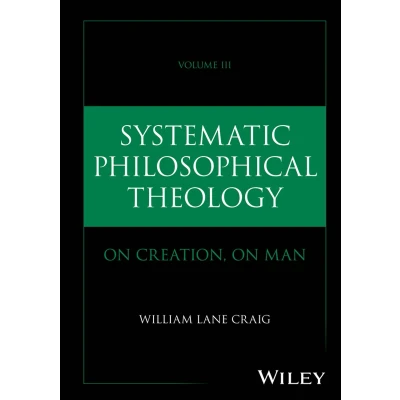
"Craig has shown himself to be deeply engaged with an astounding range of conversation partners: the natural sciences (for decades physics and cosmology, but more recently biology and paleoanthropology), analytic philosophy, historical theology, and biblical studies are all important in his work. ... I can think of no one in the world as well-suited for this project as William Lane Craig."—THOMAS McCALL, Professor of Theology, Asbury Theological Seminary "William Lane Craig's landmark treatise on systematic philosophical theology is a major contribution to our understanding of the relation of philosophy and Christian doctrine and will be an essential reference point for future discussions."—ALISTER McGRATH, Emeritus Idreos Professor of Science and Religion, Oxford University A transformative journey through Christian doctrine Volume III: On Creation, On Man William Lane Craig's Systematic Philosophical Theology is a multi-volume explication of Christian doctrine in the classic Protestant tradition of the loci communes as seen through the lens of contemporary analytic philosophy. Having treated the doctrine of God in Volume II, Craig now turns in Volume III to the loci On Creation and On Man. He treats the doctrine of creation in two parts. The first part, Creation, Conservation, and Concurrence, offers a carefully differentiated explication of these notions along with a provocative account of God, time, and creation. The second part, Providence, articulates and defends a Molinist account of God's ordinary providence, followed by a nuanced account of God's extraordinary providence, including miracles. Since any theology of creation relevant to the contemporary world must address the questions raised by origin of life studies and evolutionary biology, this locus includes a lengthy Excursus on the Origin and Evolution of Life. The locus On Man deals with theological anthropology in two parts. The first part, Man's Creation in the Image of God, explores the question of anthropological dualism and defends the view that we are embodied souls. The second part, Man as Sinner, seeks to articulate a doctrine of sin that includes postulating a universal and debilitating privation of divine, superadded grace rather than the imputation of Adam's sin to his descendants or an inherited corrupted human nature. Given the importance of the doctrine of the fall to Christian theology, the question of the historical Adam becomes urgent. Therefore, this locus includes an Excursus on the Historical Adam and Human Origins surveying the relevant biblical and scientific data. Presents a transformative journey through Christian doctrine William Lane Craig's Systematic Philosophical Theology is a multi-volume explication of Christian doctrine in the classic Protestant tradition of the loci communes as seen through the lens of contemporary analytic philosophy. Uniquely blending the disciplines of biblical theology, historical theology, and analytic theology, these volumes aim to provide readers with a biblical and philosophically coherent articulation of a wide range of Christian doctrines. In Volume III, Craig continues his ambitious project of constructing a comprehensive, interdisciplinary theological system by exploring the doctrines of creation and humanity. Building on the metaphysical groundwork laid in the preceding volume concerning the existence and nature of God, Volume III investigates the implications of divine reality for everything that exists apart from God—particularly creation and human nature. Here, theology is not approached in isolation but in dialogue with contemporary philosophical reflection and cutting-edge scientific research, resulting in a work that speaks both to traditional theological concerns and modern intellectual contexts. Volume III is distinctive in its integration of theological loci—De creation and De homine—with insights from disciplines often underrepresented in systematic theology, including organic chemistry, evolutionary biology, neurology, and paleoanthropology. The treatment of topics such as divine providence, human origins, and the Imago Dei is shaped not only by philosophical rigor and biblical exegesis but also by a robust Molinist framework. Promotes a synoptic Christian worldview that speaks to both faith and reason Bridges the gap between historical theological method and modern empirical inquiry Contributes to a diverse theological landscape with fresh perspectives on traditional concepts Provides a unique resource for theologians, philosophers, and scholars interested in science-faith integration Includes excursuses on the origin and evolution of life and the historical Adam Offering a clear and structured exposition of complex theological and philosophical topics, Systematic Philosophical Theology, Volume III, is ideal for graduate and advanced undergraduate students studying philosophy of religion, theology, or apologetics. It serves as a core or supplementary text for courses in systematic theology, philosophical theology, and Christian doctrine, and is an invaluable reference for scholars, theologians, and religious philosophers seeking a deeper understanding of the rational foundations of Christian theism.
 Productspecificaties
| EAN |
|
|---|---|
| Maat |
|
 Prijshistorie
 Prijzen voor het laatst bijgewerkt op:
 Gerelateerde resultaten


