








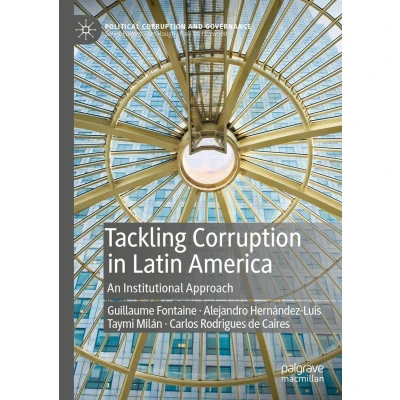
Tackling Corruption in Latin America: An Institutional Approach
Uitgelicht

|
145,00 |
Naar shop
|
 Beschrijving
Bol
It will appeal to scholars and students of public policy, public administration and governance in Latin America, as well as those interested in political corruption. This book examines anti-corruption policies in Latin America and the Caribbean. It compares best practices in public procurement and state budget in order to provide new insights on policy design for governments, civil society organisations and international organisations engaged in the fight against corruption. The book assesses how a paradigm shift toward transparency in global governance has led to major changes in public policies in the region since the late 1990s. Using Uruguay and Chile as case studies, it then demonstrates the causal mechanism linking transparency institutionalisation to corruption control. The book also offers recommendations for research and practice about the importance of coherent public accountability systems, that combine citizen oversight over government with government responsibility towards non-state actors. It will appeal to scholars and students of public policy, public administration and governance In Latin America and the Caribbean, as well as those interested in political corruption. Guillaume Fontaine is Head of the Comparative Policy Lab at the Latin American Faculty for Social Sciences (FLACSO), Ecuador. Alejandro Hernández-Luis is Associate Researcher at the Latin American Faculty for Social Sciences (FLACSO), Ecuador. Taymi Milán is Associate Researcher at the Latin American Faculty for Social Sciences (FLACSO), Ecuador. Carlos Rodrigues de Caires is Associate Researcher at the Latin American Faculty for Social Sciences (FLACSO), Ecuador This book examines anti-corruption policies in Latin America. It compares best practices in public procurement and state budgets in order to provide new insights into policy design for governments, civil society organisations and international organisations engaged in the fight against corruption. The book assesses how a paradigm shift toward transparency in global governance has led to major changes in public policies in the region since the late 1990s. Using Uruguay and Chile as case studies, it then demonstrates the causal mechanisms linking transparency institutionalisation to corruption control. The book also offers recommendations for research and practice about the importance of coherent public accountability systems, that combine citizen oversight over government with government responsibility towards non-state actors. It will appeal to scholars and students of public policy, public administration and governance in Latin America, as well as those interested in political corruption.


Vergelijk aanbieders (1)

 Beschrijving
(1)
Beschrijving
(1)
It will appeal to scholars and students of public policy, public administration and governance in Latin America, as well as those interested in political corruption. This book examines anti-corruption policies in Latin America and the Caribbean. It compares best practices in public procurement and state budget in order to provide new insights on policy design for governments, civil society organisations and international organisations engaged in the fight against corruption. The book assesses how a paradigm shift toward transparency in global governance has led to major changes in public policies in the region since the late 1990s. Using Uruguay and Chile as case studies, it then demonstrates the causal mechanism linking transparency institutionalisation to corruption control. The book also offers recommendations for research and practice about the importance of coherent public accountability systems, that combine citizen oversight over government with government responsibility towards non-state actors. It will appeal to scholars and students of public policy, public administration and governance In Latin America and the Caribbean, as well as those interested in political corruption. Guillaume Fontaine is Head of the Comparative Policy Lab at the Latin American Faculty for Social Sciences (FLACSO), Ecuador. Alejandro Hernández-Luis is Associate Researcher at the Latin American Faculty for Social Sciences (FLACSO), Ecuador. Taymi Milán is Associate Researcher at the Latin American Faculty for Social Sciences (FLACSO), Ecuador. Carlos Rodrigues de Caires is Associate Researcher at the Latin American Faculty for Social Sciences (FLACSO), Ecuador This book examines anti-corruption policies in Latin America. It compares best practices in public procurement and state budgets in order to provide new insights into policy design for governments, civil society organisations and international organisations engaged in the fight against corruption. The book assesses how a paradigm shift toward transparency in global governance has led to major changes in public policies in the region since the late 1990s. Using Uruguay and Chile as case studies, it then demonstrates the causal mechanisms linking transparency institutionalisation to corruption control. The book also offers recommendations for research and practice about the importance of coherent public accountability systems, that combine citizen oversight over government with government responsibility towards non-state actors. It will appeal to scholars and students of public policy, public administration and governance in Latin America, as well as those interested in political corruption.
 Productspecificaties
| EAN |
|
|---|---|
| Maat |
|
 Prijshistorie
Prijzen voor het laatst bijgewerkt op:
 Gerelateerde resultaten


