


€ 30,99 Gratis verzending

Gesponsorde links
|
|
30,99 |
Naar shop
|

|
32,20 |
Naar shop
|

|
32,20 |
Naar shop
|
| VERGELIJK ALLE AANBIEDERS (3) | ||
 Beschrijving
Vergelijk aanbieders (3)
Gesponsorde links · Sommige shops betalen ons een vergoeding
€ 30,99 Gratis verzending
€ 32,20 Gratis verzending
€ 32,20 Gratis verzending
Winkels met andere maten
Beschrijving
(1)
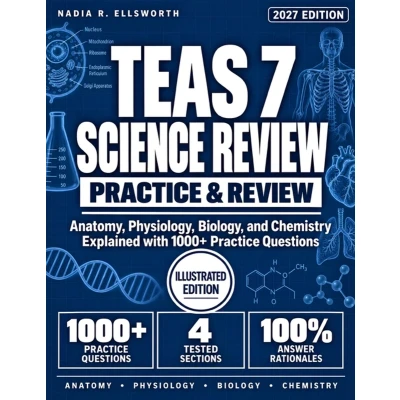
The Science section rewards more than memory.Science questions rarely ask you to recite a fact. They present a situation - a graph, an experiment, a patient scenario, a chemical change - and ask what it implies. The useful skill is recognising which system or principle a question is really about, then reasoning from it under time pressure.A student who has memorised the parts of the nephron and a student who understands what the nephron is regulating will answer very different proportions of this section correctly. This book is written to produce the second student.What is inside- 20 chapters covering section strategy and a diagnostic baseline, measurement and scientific tools, scientific method and experimental reasoning, anatomical orientation and tissues, and then the body systems in an order where each one builds on the last: respiratory, cardiovascular, digestive, nervous, muscular and skeletal, endocrine, urinary and reproductive, integumentary and immune.- Cell biology, genetics and chemistry placed where they make sense - cell structure, DNA and protein synthesis, Mendelian inheritance and probability, macromolecules and microorganisms, atomic structure, reactions and reaction rate, solutions, acids, bases and pH.- More than 1,000 practice questions, positioned inside each chapter rather than at the back, so recall is tested while the explanation is still fresh.- Worked rationales throughout, plus answer keys and teaching explanations that name the reasoning step, not just the correct letter.- A full mixed Science capstone examination with rationales and a final remediation plan.- Remediation maps at chapter level that point from the kind of mistake you made to the specific section that fixes it - so review is targeted rather than a re-read.- Richly illustrated anatomical and scientific figures supporting every system as it is introduced.Who it is forApplicants to nursing and allied-health programmes who find Science the hardest section, students returning to study after time away, and anyone who has taken a practice test and discovered that recognising the content is not the same as recalling it.How to work itRead the chapter objectives first. Answer the questions before reading the explanations - recognition feels like knowledge while the text is still on the page, and recall under a blank page is what is actually measured.Independent study aid. Not endorsed by, affiliated with or sponsored by Assessment Technologies Institute, L.L.C. (ATI). TEAS and ATI TEAS are trademarks of Assessment Technologies Institute, L.L.C., cited for identification and educational reference only. All questions in this book are original and are not reproduced from any actual examination. Examination content and policy are set by the test owner and can change; confirm current requirements before your test date.
 Prijshistorie
* Prijshistorie bevat geen data van Amazon, Amazon Marketplace.
Prijzen voor het laatst bijgewerkt op:
 Gerelateerde resultaten
 Productspecificaties


