

€ 18,36 Gratis verzending

Uitgelicht
|
|
18,36 |
Naar shop
|

|
18,36 |
Naar shop
|

|
20,99 |
Naar shop
|
| VERGELIJK ALLE AANBIEDERS (3) | ||
 Beschrijving
Vergelijk aanbieders (3)
€ 18,36 Gratis verzending
€ 18,36 Gratis verzending
€ 20,99 € 2,99 verzendkosten Totaal € 23,98
Winkels met andere maten
Beschrijving
(1)
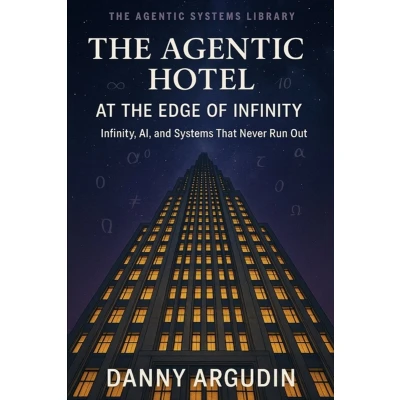
The infinite hotel at the edge of everything has never had a vacancy. Every room is occupied. And yet - when a new guest arrives - the desk clerk always makes room. The shift is simple: every guest moves one room forward, Room 1 opens, the new guest enters. The hotel was full before. The hotel is full now. It holds one more guest than before.This is Hilbert's Hotel. It is also the operating model of every well-designed AI system."The Agentic Hotel at the Edge of Infinity" uses the mathematics of the infinite - real mathematics, real theorems - to give practitioners a rigorous framework for understanding and building agentic AI systems that scale without artificial ceilings. Author Danny Argudin, who built and operates a multi-agent AI operating system, draws on two years of applied agentic development to translate formal mathematical results into design principles that practitioners can use starting today.The framework covers fourteen interconnected ideas: - The Hilbert Shift: how to design session handoffs so context compaction is lossless in operation - because the hotel always makes room, but only if the shift is done correctly - Cantor's Diagonal: why your agent registry will always have gaps, and how to turn the fallback rate from a failure metric into an oracle for what to build next - Zeno's Convergence Proof: why the WIP limit is not a throttle on ambition but a mathematical guarantee that the queue converges - Ramsey's Theorem: why agent subgroups organize themselves as the registry grows - structure appears whether you designed it or not - Conway's Gliders: how to recognize the recurring agent-chain patterns that no one designed but that consistently produce your best outcomes - Godel's Incompleteness Theorems: why the human review gate is not just a governance requirement but an epistemic necessity - the mechanism by which your system accesses truths about itself that no formal system can derive from withinAnd the vine: the theological and philosophical context that grounds the whole framework in a tradition that says the hotel's infinite capacity is not its own property but the echo of something inexhaustible from which it was built.The mathematics in this book is real. The applications are practical. The hotel always has room - and this book shows you how to build systems that inherit that property.For practitioners building multi-agent AI systems who want a rigorous framework, not just a metaphor.
 Prijshistorie
 * Prijshistorie bevat geen data van Amazon, Amazon Marketplace.
Prijzen voor het laatst bijgewerkt op:
 Gerelateerde resultaten
 Productspecificaties


