
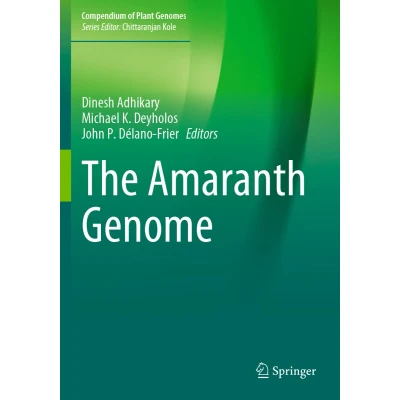
The Amaranth Genome
Uitgelicht

|
175,00
169,00 |
Naar shop
|
| VERGELIJK ALLE AANBIEDERS (1) | ||
 Beschrijving
Bol
This book describes the development of genetic resources in amaranths, with a major focus on genomics, reverse, and forward genetics tools and strategies that have been developed for crop improvement. This book describes the development of genetic resources in amaranths, with a major focus on genomics, reverse, and forward genetics tools and strategies that have been developed for crop improvement. Amaranth is an ancient crop native to the New World. Interest in amaranths is being renewed, due to their adaptability, stress tolerance, and nutritional value. There are about 65 species in the genus, including Amaranthus caudatus L., A. cruentus L., and A. hypochondriacus L., which are primarily grown as protein-rich grains or pseudocereals. The genus also includes major noxious weeds (e.g., A. palmeri). The amaranths are within the Caryophyllales order and thus many species (e.g., A. tricolor) produce red (betacyanin) or yellow (betaxanthin) betalain pigments, which are chemically distinct from the anthocyanins responsible for red pigmentation in other plants. A. hypochondriacus, which shows disomic inheritance (2n = 32; n= 466 Mb), has been sequenced and annotated with 23,059 protein-coding genes. Additional members of the genus are now also been sequenced including weedy amaranths, other grain amaranths, and their putative progenitors. This book describes the development of genetic resources in amaranths, with a major focus on genomics, reverse, and forward genetics tools and strategies that have been developed for crop improvement. Amaranth is an ancient crop native to the New World. Interest in amaranths is being renewed, due to their adaptability, stress tolerance, and nutritional value. There are about 65 species in the genus, including Amaranthus caudatus L., A. cruentus L., and A. hypochondriacus L., which are primarily grown as protein-rich grains or pseudocereals. The genus also includes major noxious weeds (e.g., A. palmeri). The amaranths are within the Caryophyllales order and thus many species (e.g., A. tricolor) produce red (betacyanin) or yellow (betaxanthin) betalain pigments, which are chemically distinct from the anthocyanins responsible for red pigmentation in other plants. A. hypochondriacus, which shows disomic inheritance (2n = 32; n= 466 Mb), has been sequenced and annotated with 23,059 protein-coding genes. Additional members of the genus are now also been sequenced including weedy amaranths, other grain amaranths, and their putative progenitors.


Vergelijk aanbieders (1)

 Beschrijving
(1)
Beschrijving
(1)
This book describes the development of genetic resources in amaranths, with a major focus on genomics, reverse, and forward genetics tools and strategies that have been developed for crop improvement. This book describes the development of genetic resources in amaranths, with a major focus on genomics, reverse, and forward genetics tools and strategies that have been developed for crop improvement. Amaranth is an ancient crop native to the New World. Interest in amaranths is being renewed, due to their adaptability, stress tolerance, and nutritional value. There are about 65 species in the genus, including Amaranthus caudatus L., A. cruentus L., and A. hypochondriacus L., which are primarily grown as protein-rich grains or pseudocereals. The genus also includes major noxious weeds (e.g., A. palmeri). The amaranths are within the Caryophyllales order and thus many species (e.g., A. tricolor) produce red (betacyanin) or yellow (betaxanthin) betalain pigments, which are chemically distinct from the anthocyanins responsible for red pigmentation in other plants. A. hypochondriacus, which shows disomic inheritance (2n = 32; n= 466 Mb), has been sequenced and annotated with 23,059 protein-coding genes. Additional members of the genus are now also been sequenced including weedy amaranths, other grain amaranths, and their putative progenitors. This book describes the development of genetic resources in amaranths, with a major focus on genomics, reverse, and forward genetics tools and strategies that have been developed for crop improvement. Amaranth is an ancient crop native to the New World. Interest in amaranths is being renewed, due to their adaptability, stress tolerance, and nutritional value. There are about 65 species in the genus, including Amaranthus caudatus L., A. cruentus L., and A. hypochondriacus L., which are primarily grown as protein-rich grains or pseudocereals. The genus also includes major noxious weeds (e.g., A. palmeri). The amaranths are within the Caryophyllales order and thus many species (e.g., A. tricolor) produce red (betacyanin) or yellow (betaxanthin) betalain pigments, which are chemically distinct from the anthocyanins responsible for red pigmentation in other plants. A. hypochondriacus, which shows disomic inheritance (2n = 32; n= 466 Mb), has been sequenced and annotated with 23,059 protein-coding genes. Additional members of the genus are now also been sequenced including weedy amaranths, other grain amaranths, and their putative progenitors.
 Productspecificaties
| EAN |
|
|---|---|
| Maat |
|
 Prijshistorie
Prijzen voor het laatst bijgewerkt op:
 Gerelateerde resultaten


