
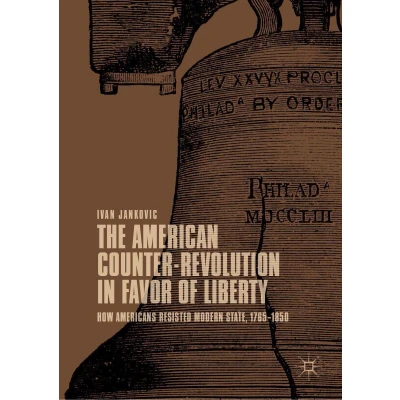
The American Counter Revolution in Favor of Liberty
Uitgelicht

|
93,67 |
Naar shop
|

|
98,09 |
Naar shop
|
| VERGELIJK ALLE AANBIEDERS (2) | ||
 Beschrijving
Bol Partner
This book presents the case that the origins of American liberty should not be sought in the constitutional-reformist feats of its “statesmen” during the 1780s, but rather in the political and social resistance to their efforts. This book presents the case that the origins of American liberty should not be sought in the constitutional-reformist feats of its “statesmen” during the 1780s, but rather in the political and social resistance to their efforts. There were two revolutions occurring in the late 18th century America: the modern European revolution “in favour of government,” pursuing national unity, “energetic” government and centralization of power (what scholars usually dub “American founding”); and a conservative, reactionary counter-revolution “in favour of liberty,” defending local rights and liberal individualism against the encroaching political authority. This is a book about this liberal counter-revolution and its ideological, political and cultural sources and central protagonists. The central analytical argument of the book is that America before the Revolution was a stateless, spontaneous political order that evolved culturally, politically and economically in isolation from the modern European trends of state-building and centralization of power. The book argues, then, that a better model for understanding America is a “decoupled modernization” hypothesis, in which social modernity is divested from the politics of modern state and tied with the pre-modern social institutions. This book presents the case that the origins of American liberty should not be sought in the constitutional-reformist feats of its “statesmen” during the 1780s, but rather in the political and social resistance to their efforts. There were two revolutions occurring in the late 18th century America: the modern European revolution “in favour of government,” pursuing national unity, “energetic” government and centralization of power (what scholars usually dub “American founding”); and a conservative, reactionary counter-revolution “in favour of liberty,” defending local rights and liberal individualism against the encroaching political authority. This is a book about this liberal counter-revolution and its ideological, political and cultural sources and central protagonists. The central analytical argument of the book is that America before the Revolution was a stateless, spontaneous political order that evolved culturally, politically and economically in isolation from the modern European trends of state-building and centralization of power. The book argues, then, that a better model for understanding America is a “decoupled modernization” hypothesis, in which social modernity is divested from the politics of modern state and tied with the pre-modern social institutions.


 Beschrijving
(2)
Beschrijving
(2)
This book presents the case that the origins of American liberty should not be sought in the constitutional-reformist feats of its “statesmen” during the 1780s, but rather in the political and social resistance to their efforts. This book presents the case that the origins of American liberty should not be sought in the constitutional-reformist feats of its “statesmen” during the 1780s, but rather in the political and social resistance to their efforts. There were two revolutions occurring in the late 18th century America: the modern European revolution “in favour of government,” pursuing national unity, “energetic” government and centralization of power (what scholars usually dub “American founding”); and a conservative, reactionary counter-revolution “in favour of liberty,” defending local rights and liberal individualism against the encroaching political authority. This is a book about this liberal counter-revolution and its ideological, political and cultural sources and central protagonists. The central analytical argument of the book is that America before the Revolution was a stateless, spontaneous political order that evolved culturally, politically and economically in isolation from the modern European trends of state-building and centralization of power. The book argues, then, that a better model for understanding America is a “decoupled modernization” hypothesis, in which social modernity is divested from the politics of modern state and tied with the pre-modern social institutions. This book presents the case that the origins of American liberty should not be sought in the constitutional-reformist feats of its “statesmen” during the 1780s, but rather in the political and social resistance to their efforts. There were two revolutions occurring in the late 18th century America: the modern European revolution “in favour of government,” pursuing national unity, “energetic” government and centralization of power (what scholars usually dub “American founding”); and a conservative, reactionary counter-revolution “in favour of liberty,” defending local rights and liberal individualism against the encroaching political authority. This is a book about this liberal counter-revolution and its ideological, political and cultural sources and central protagonists. The central analytical argument of the book is that America before the Revolution was a stateless, spontaneous political order that evolved culturally, politically and economically in isolation from the modern European trends of state-building and centralization of power. The book argues, then, that a better model for understanding America is a “decoupled modernization” hypothesis, in which social modernity is divested from the politics of modern state and tied with the pre-modern social institutions.
BolThis book presents the case that the origins of American liberty should not be sought in the constitutional-reformist feats of its “statesmen” during the 1780s, but rather in the political and social resistance to their efforts. There were two revolutions occurring in the late 18th century America: the modern European revolution “in favour of government,” pursuing national unity, “energetic” government and centralization of power (what scholars usually dub “American founding”); and a conservative, reactionary counter-revolution “in favour of liberty,” defending local rights and liberal individualism against the encroaching political authority. This is a book about this liberal counter-revolution and its ideological, political and cultural sources and central protagonists. The central analytical argument of the book is that America before the Revolution was a stateless, spontaneous political order that evolved culturally, politically and economically in isolation from the modern European trends of state-building and centralization of power. The book argues, then, that a better model for understanding America is a “decoupled modernization” hypothesis, in which social modernity is divested from the politics of modern state and tied with the pre-modern social institutions.
 Productspecificaties
| EAN |
|
|---|---|
| Maat |
|
 Prijshistorie
Prijzen voor het laatst bijgewerkt op:
 Gerelateerde resultaten


