
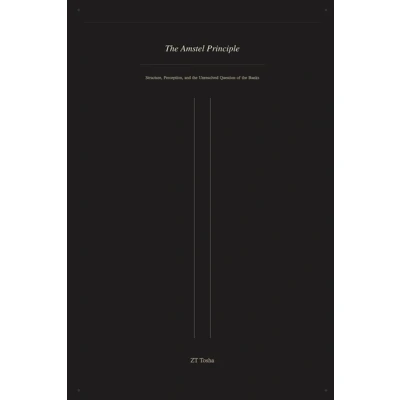
The Amstel Principle
Uitgelicht

|
16,00 |
Naar shop
|

|
17,57 |
Naar shop
|

|
17,57 |
Naar shop
|
| VERGELIJK ALLE AANBIEDERS (3) | ||
 Beschrijving
Bol
The Amstel River was once one hundred fifty metres wide.Now it is twenty. Someone narrowed it. The water obeyedbecause it had no choice.That observation becomes a principle: form requires constraint.Without banks, no river. Without constraint, no form.Without form, no meaning.But the question that follows will not close: who decideswhere the banks go?ZT Tosha walks the banks of the Amstel on an April morningand does not come back the same. He climbs the windingstaircase of the Westertoren - eighty steps of narrowingstone - and discovers that the constraint produces the view, not despite itself but because of it. He sits on a boat movingthrough the Amsterdam Light Festival in the darkest week ofthe year and understands, all at once, that he is inside asystem. He returns every June to the same fishmonger at theAlbert Cuyp for the new herring - the same address, adifferent floor, a different man - and finds the spiral wherehe expected a circle. He visits the cherry blossom park inDe Pijp after curfew, alone in the dark, and receives somethingthe government decree did not plan for him to receive. He walkshome through streets whose names carry the memory of waterthat has not been there for seven hundred years.The places in this book are real. You can walk them.The philosophy grows from the ground up.Drawing on Aristotle, Camus, Euripides, and the Hermetictradition, The Amstel Principle builds a philosophical systemfrom the clay beneath Dam Square and the ghost river beneaththe Rokin. It asks what happens when constraint becomesinvisible - when the banks are so old we mistake them fornature. When the structure we built to hold the water becomesthe only water we remember.This is not an abstract argument. It is a record of sustainedlooking. The book is built from short sections and white space, because the silence is part of the thinking. Each chapter is aplace. Each place is a question. The questions do not resolve.They accumulate.Aristotle could not give you the fragrance of cherry blossomat twenty-one hundred hours in an empty park under a curfew.That you have to live. This book lives it.Once you see the banks, you cannot unsee them.That is the cost. That is also the point.ZT Tosha is the pseudonym of Zoran Tosic, born 1961 inMostar, former Yugoslavia. He lives and works in Amsterdam.His practice moves across painting, installation, and writing, all asking how perception constructs reality rather thanreceives it. His paintings use deliberate blur as the removalof hierarchy. His installations give physical form to whatconstraint produces. His writing uses the sentence the waypainting uses the blur. He is the author of five books: A Garden for Orpheus (2024), The Invention of Andreas (2024), The Assembler, Disassembled (2025), The Inherited Throne(2026), and this one.


 Beschrijving
(1)
Beschrijving
(1)
The Amstel River was once one hundred fifty metres wide.Now it is twenty. Someone narrowed it. The water obeyedbecause it had no choice.That observation becomes a principle: form requires constraint.Without banks, no river. Without constraint, no form.Without form, no meaning.But the question that follows will not close: who decideswhere the banks go?ZT Tosha walks the banks of the Amstel on an April morningand does not come back the same. He climbs the windingstaircase of the Westertoren - eighty steps of narrowingstone - and discovers that the constraint produces the view, not despite itself but because of it. He sits on a boat movingthrough the Amsterdam Light Festival in the darkest week ofthe year and understands, all at once, that he is inside asystem. He returns every June to the same fishmonger at theAlbert Cuyp for the new herring - the same address, adifferent floor, a different man - and finds the spiral wherehe expected a circle. He visits the cherry blossom park inDe Pijp after curfew, alone in the dark, and receives somethingthe government decree did not plan for him to receive. He walkshome through streets whose names carry the memory of waterthat has not been there for seven hundred years.The places in this book are real. You can walk them.The philosophy grows from the ground up.Drawing on Aristotle, Camus, Euripides, and the Hermetictradition, The Amstel Principle builds a philosophical systemfrom the clay beneath Dam Square and the ghost river beneaththe Rokin. It asks what happens when constraint becomesinvisible - when the banks are so old we mistake them fornature. When the structure we built to hold the water becomesthe only water we remember.This is not an abstract argument. It is a record of sustainedlooking. The book is built from short sections and white space, because the silence is part of the thinking. Each chapter is aplace. Each place is a question. The questions do not resolve.They accumulate.Aristotle could not give you the fragrance of cherry blossomat twenty-one hundred hours in an empty park under a curfew.That you have to live. This book lives it.Once you see the banks, you cannot unsee them.That is the cost. That is also the point.ZT Tosha is the pseudonym of Zoran Tosic, born 1961 inMostar, former Yugoslavia. He lives and works in Amsterdam.His practice moves across painting, installation, and writing, all asking how perception constructs reality rather thanreceives it. His paintings use deliberate blur as the removalof hierarchy. His installations give physical form to whatconstraint produces. His writing uses the sentence the waypainting uses the blur. He is the author of five books: A Garden for Orpheus (2024), The Invention of Andreas (2024), The Assembler, Disassembled (2025), The Inherited Throne(2026), and this one.
 Productspecificaties
 Prijshistorie
* Prijshistorie bevat geen data van Amazon, Amazon Marketplace.
Prijzen voor het laatst bijgewerkt op:
 Gerelateerde resultaten


