


€ 13,00 € 2,99 verzendkosten Totaal € 15,99

Uitgelicht
|
|
13,00 |
Naar shop
|

|
13,78 |
Naar shop
|

|
13,78 |
Naar shop
|
| VERGELIJK ALLE AANBIEDERS (3) | ||
 Beschrijving
Vergelijk aanbieders (3)
€ 13,00 € 2,99 verzendkosten Totaal € 15,99
€ 13,78 Gratis verzending
€ 13,78 Gratis verzending
Winkels met andere maten
Beschrijving
(1)
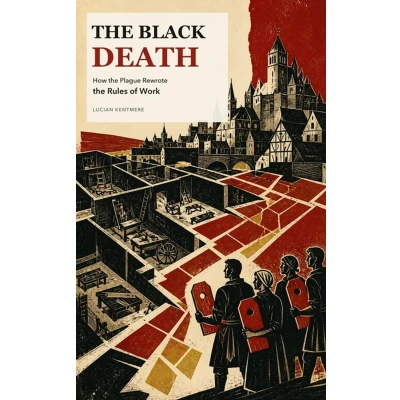
This is a history of the plague that killed at least a third of Europe, told through the wage law it produced rather than the images most people picture when they hear its name. Those images are wrong: the beaked mask worn by plague doctors belongs to the seventeenth century, invented nearly three hundred years after 1348, and the name "Black Death" itself was coined by German scholars in 1832, not by anyone who lived through it.It follows the plague from the siege of Caffa and the ships that reached Messina in 1347 to the order an English government issued in the middle of the dying: the Ordinance of Labourers of 18 June 1349, which tried to freeze wages at pre-plague rates and was defied within a generation. Fields went uncultivated and the price of labor rose across Europe for a hundred years. In the west, that pressure helped dissolve serfdom. East of the Elbe, the same shock produced the opposite outcome: a second serfdom that lasted into the nineteenth century.It gives the killings of Jewish communities across German and Swiss towns in 1348 and 1349 their own full chapter, tracing the well-poisoning accusation that outlived the epidemic by centuries. It follows the plague's return in 1361 and a dozen further waves before its last English outbreak in 1665.By the time the sickness receded, the wage a laborer could demand, the rent a lord could collect, and the price of a manor had all changed permanently. No later century's mortality would move Europe's economy so far in one direction.Lucian Kentmere draws on manorial court rolls, bishops' registers, chronicles and three generations of demographic scholarship to tell this as a history of what a shock does to a labor market, not only a chronicle of who died.
 Prijshistorie
 * Prijshistorie bevat geen data van Amazon, Amazon Marketplace.
Prijzen voor het laatst bijgewerkt op:
 Gerelateerde resultaten
 Productspecificaties


