
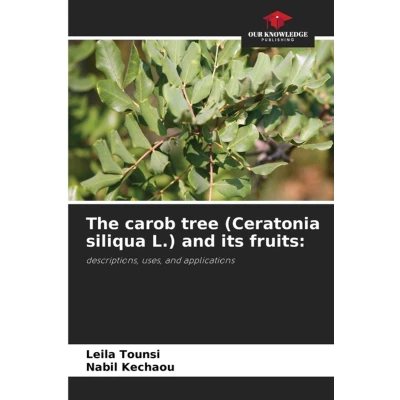
The carob tree (Ceratonia siliqua L.) and its fruits:: descriptions, uses, applications
Uitgelicht

|
47,15 |
Naar shop
|

|
47,15 |
Naar shop
|

|
48,99 |
Naar shop
|
| VERGELIJK ALLE AANBIEDERS (3) | ||
 Beschrijving
Bol
The scientific name of the carob tree (Ceratonia siliqua L.) derives from the Greek word *keras*, meaning "horn," and the Latin word *siliqua*, meaning "silique" or "pod." This name aptly describes the hardness and shape of the fruit (Battle and Tous, 1997). The dialectal name varies by language; for example, it is called kharroub in Arabic, caroubier in French, carroubo in Italian, algarrobo in Spanish, and alfarrobeira in Portuguese (Battle and Tous, 1997). The carob tree is a tree with abundant, evergreen, and very dense foliage. It reaches a height of 7 to 10 m and has a trunk circumference at the base of 2 to 3 m (Figure I.1). It can grow to a height of 15 to 20 m under favorable environmental conditions (Battle and Tous, 1997). It is characterized by very hard, reddish wood, rough brown bark, sturdy branches, and strong roots that penetrate the soil to a depth of 18 m or even more. Its growth is very slow, especially early in its development, and it has a considerable lifespan of up to 200 years (Ait Chitt et al., 2007).


 Beschrijving
(1)
Beschrijving
(1)
The scientific name of the carob tree (Ceratonia siliqua L.) derives from the Greek word *keras*, meaning "horn," and the Latin word *siliqua*, meaning "silique" or "pod." This name aptly describes the hardness and shape of the fruit (Battle and Tous, 1997). The dialectal name varies by language; for example, it is called kharroub in Arabic, caroubier in French, carroubo in Italian, algarrobo in Spanish, and alfarrobeira in Portuguese (Battle and Tous, 1997). The carob tree is a tree with abundant, evergreen, and very dense foliage. It reaches a height of 7 to 10 m and has a trunk circumference at the base of 2 to 3 m (Figure I.1). It can grow to a height of 15 to 20 m under favorable environmental conditions (Battle and Tous, 1997). It is characterized by very hard, reddish wood, rough brown bark, sturdy branches, and strong roots that penetrate the soil to a depth of 18 m or even more. Its growth is very slow, especially early in its development, and it has a considerable lifespan of up to 200 years (Ait Chitt et al., 2007).
 Productspecificaties
 Prijshistorie
* Prijshistorie bevat geen data van Amazon, Amazon Marketplace.
Prijzen voor het laatst bijgewerkt op:
 Gerelateerde resultaten


