
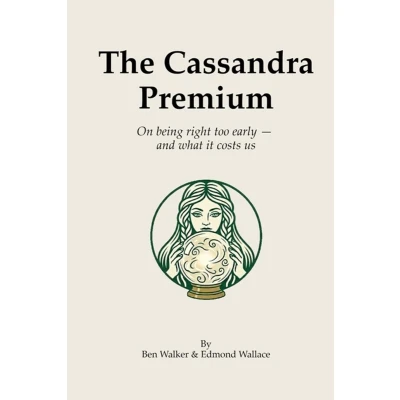
The Cassandra Premium: On being right too early — and what it costs us
Uitgelicht

|
15,00 |
Naar shop
|

|
15,72 |
Naar shop
|

|
15,72 |
Naar shop
|
| VERGELIJK ALLE AANBIEDERS (3) | ||
 Beschrijving
Bol
A book about who pays the price for being right too early - and how to identify the people who will be right before the rest of the world catches up. In Greek mythology, Cassandra was cursed to see the future and never be believed. Troy burned. The myth has survived three thousand years because it describes something that does not require mythology to explain. It is a recurring structural feature of how human beings and human institutions process warnings about slow-moving threats. They don't, until the threat is no longer slow-moving. The person who was right early pays a price for their accuracy. The price is not punishment. It is something quieter and in some ways worse: they are simply not believed. This book is about that price. About who pays it, why it is extracted, and - most practically - how a thoughtful person who is not an expert in any of the relevant fields can learn to identify the people who are going to be right before the rest of the world catches up. >The book builds outward from that case. It develops a five-criterion framework for identifying experts whose warnings should be taken seriously. It applies the framework to five domains where similar warnings are being issued right now and similarly ignored. And it asks the reader to consider their own exposure - financial, geographic, occupational, institutional - to the kinds of structural failures that experts have already named and that the world is mostly not preparing for. Cassandra was right about Troy. The cost of her being right was that Troy burned anyway.


 Beschrijving
(1)
Beschrijving
(1)
A book about who pays the price for being right too early - and how to identify the people who will be right before the rest of the world catches up. In Greek mythology, Cassandra was cursed to see the future and never be believed. Troy burned. The myth has survived three thousand years because it describes something that does not require mythology to explain. It is a recurring structural feature of how human beings and human institutions process warnings about slow-moving threats. They don't, until the threat is no longer slow-moving. The person who was right early pays a price for their accuracy. The price is not punishment. It is something quieter and in some ways worse: they are simply not believed. This book is about that price. About who pays it, why it is extracted, and - most practically - how a thoughtful person who is not an expert in any of the relevant fields can learn to identify the people who are going to be right before the rest of the world catches up. >The book builds outward from that case. It develops a five-criterion framework for identifying experts whose warnings should be taken seriously. It applies the framework to five domains where similar warnings are being issued right now and similarly ignored. And it asks the reader to consider their own exposure - financial, geographic, occupational, institutional - to the kinds of structural failures that experts have already named and that the world is mostly not preparing for. Cassandra was right about Troy. The cost of her being right was that Troy burned anyway.
 Productspecificaties
 Prijshistorie
* Prijshistorie bevat geen data van Amazon, Amazon Marketplace.
Prijzen voor het laatst bijgewerkt op:
 Gerelateerde resultaten


