
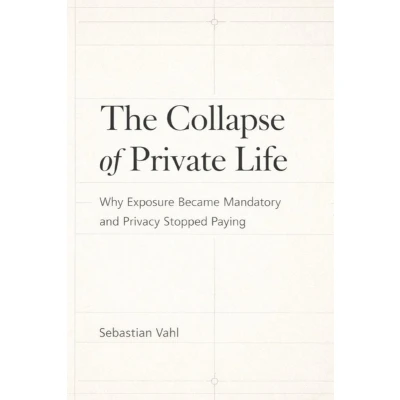
The Collapse of Private Life: Why Exposure Became Mandatory and Privacy Stopped Paying
Uitgelicht

|
9,29 |
Naar shop
|

|
10,50 |
Naar shop
|
| VERGELIJK ALLE AANBIEDERS (2) | ||
 Beschrijving
Bol
Most people today understand themselves better than any generation before them. They talk openly. They explain their choices. They narrate their lives.Yet something essential has disappeared.Private life did not vanish because people stopped valuing it. It collapsed because modern systems stopped protecting it.In The Collapse of Private Life, Sebastian Vahl shows how privacy was never a personal preference or moral stance. It was a structural condition. It existed only as long as institutions, norms, and incentives made restraint viable and opacity useful.That condition no longer holds.Visibility now produces opportunity. Exposure reduces risk. Silence creates suspicion. Under those incentives, disclosure becomes rational and privacy becomes fragile, even for those who want it.This book explains how that inversion occurred and why individual fixes fail.Vahl traces how exposure quietly became mandatory across work, relationships, leadership, creativity, and identity itself. He shows why boundary-setting collapses without collective enforcement, why withdrawal feels like disappearance, and why even powerful people struggle to maintain interior space.This is not a book about technology panic, oversharing, or personal discipline.It is an explanation of how modern life reorganized itself around legibility, and what that reorganization costs.


 Beschrijving
(1)
Beschrijving
(1)
Most people today understand themselves better than any generation before them. They talk openly. They explain their choices. They narrate their lives.Yet something essential has disappeared.Private life did not vanish because people stopped valuing it. It collapsed because modern systems stopped protecting it.In The Collapse of Private Life, Sebastian Vahl shows how privacy was never a personal preference or moral stance. It was a structural condition. It existed only as long as institutions, norms, and incentives made restraint viable and opacity useful.That condition no longer holds.Visibility now produces opportunity. Exposure reduces risk. Silence creates suspicion. Under those incentives, disclosure becomes rational and privacy becomes fragile, even for those who want it.This book explains how that inversion occurred and why individual fixes fail.Vahl traces how exposure quietly became mandatory across work, relationships, leadership, creativity, and identity itself. He shows why boundary-setting collapses without collective enforcement, why withdrawal feels like disappearance, and why even powerful people struggle to maintain interior space.This is not a book about technology panic, oversharing, or personal discipline.It is an explanation of how modern life reorganized itself around legibility, and what that reorganization costs.
 Productspecificaties
 Prijshistorie
* Prijshistorie bevat geen data van Amazon.
Prijzen voor het laatst bijgewerkt op:
 Gerelateerde resultaten


