


€ 31,67 Gratis verzending

Uitgelicht
|
|
31,67 |
Naar shop
|

|
33,17 |
Naar shop
|

|
33,17 |
Naar shop
|
| VERGELIJK ALLE AANBIEDERS (3) | ||
 Beschrijving
Vergelijk aanbieders (3)
€ 31,67 Gratis verzending
€ 33,17 Gratis verzending
€ 33,17 Gratis verzending
Winkels met andere maten
Beschrijving
(1)
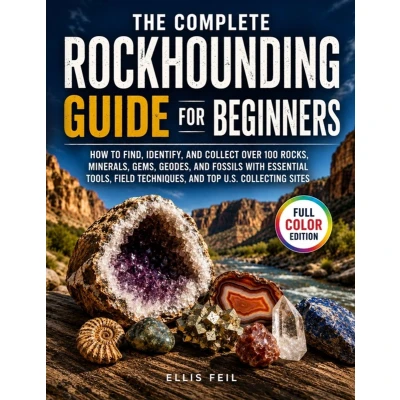
Most people who try rockhounding come home with pebbles they cannot name from land they were not sure they were allowed to be on. The problem is almost never the tools or the location. It is the sequence of knowledge that most beginner resources skip: where to look before you leave home, how to read the geological signals that tell you which terrain concentrates collectible material and which is barren, and what the actual legal framework permits on BLM land, National Forests, and state-administered sites. Most guides address one of these. Very few address all three in the order that makes them immediately useful on a first real field trip. The Return on Geological Thinking - Read geological maps to target productive ground before ever leaving home- Apply a seven-step physical identification sequence to any unknown rock or mineral- Build a staged tool kit matched to your actual collecting activity, not a wishlist- Navigate BLM, National Forest, and state land rules with accuracy and confidence- Crack geodes cleanly, prepare specimens correctly, and store fragile material safely- Understand fossil collecting law, including where vertebrate material draws federal penalties- Locate agate, jasper, obsidian, geodes, shark teeth, and crystals at over 25 U.S. sites Geological Reasoning as Field Method Every chapter is sequenced around one principle: geological reasoning before field technique, and field technique before specimen identification. You learn why volcanic voids produce agates, why marine limestone contains fossils, and why the contact zone between an igneous intrusion and surrounding terrain concentrates the most collectible minerals in any given area, because that understanding converts a blind search into a solvable problem. This book teaches the full sequence, from reading a geological map before you leave home to following the seven-step physical identification process the moment something interesting appears in your hand. > This is the book that goes in the day pack. Add it to your shelf before the first trip.
 Prijshistorie
 * Prijshistorie bevat geen data van Amazon, Amazon Marketplace.
Prijzen voor het laatst bijgewerkt op:
 Gerelateerde resultaten
 Productspecificaties


