
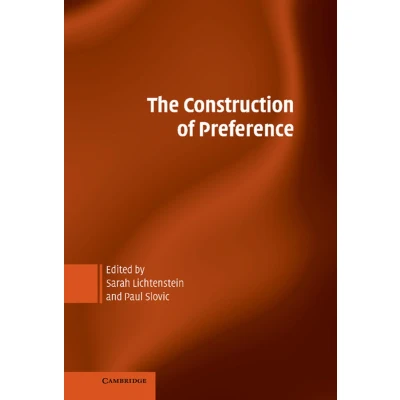
The Construction of Preference
Uitgelicht

|
93,99 |
Naar shop
|
| VERGELIJK ALLE AANBIEDERS (1) | ||
 Beschrijving
Bol
One of the main themes that has emerged from behavioral decision research during the past three decades is the view that people's preferences are often constructed in the process of elicitation. This idea is derived from studies demonstrating that normatively equivalent methods of elicitation (e.g., choice and pricing) give rise to systematically different responses. These preference reversals violate the principle of procedure invariance that is fundamental to all theories of rational choice. If different elicitation procedures produce different orderings of options, how can preferences be defined and in what sense do they exist? This book shows not only the historical roots of preference construction but also the blossoming of the concept within psychology, law, marketing, philosophy, environmental policy, and economics. Decision making is now understood to be a highly contingent form of information processing, sensitive to task complexity, time pressure, response mode, framing, reference points, and other contextual factors.


Vergelijk aanbieders (1)

 Beschrijving
(1)
Beschrijving
(1)
One of the main themes that has emerged from behavioral decision research during the past three decades is the view that people's preferences are often constructed in the process of elicitation. This idea is derived from studies demonstrating that normatively equivalent methods of elicitation (e.g., choice and pricing) give rise to systematically different responses. These preference reversals violate the principle of procedure invariance that is fundamental to all theories of rational choice. If different elicitation procedures produce different orderings of options, how can preferences be defined and in what sense do they exist? This book shows not only the historical roots of preference construction but also the blossoming of the concept within psychology, law, marketing, philosophy, environmental policy, and economics. Decision making is now understood to be a highly contingent form of information processing, sensitive to task complexity, time pressure, response mode, framing, reference points, and other contextual factors.
 Productspecificaties
| EAN |
|
|---|---|
| Maat |
|
 Prijshistorie
Prijzen voor het laatst bijgewerkt op:
 Gerelateerde resultaten


