

€ 12,99 Gratis verzending

Uitgelicht
|
|
12,99 |
Naar shop
|

|
12,99 |
Naar shop
|

|
13,27 |
Naar shop
|
| VERGELIJK ALLE AANBIEDERS (3) | ||
 Beschrijving
Vergelijk aanbieders (3)
€ 12,99 Gratis verzending
€ 12,99 Gratis verzending
€ 13,27 € 2,99 verzendkosten Totaal € 16,26
Winkels met andere maten
Beschrijving
(1)
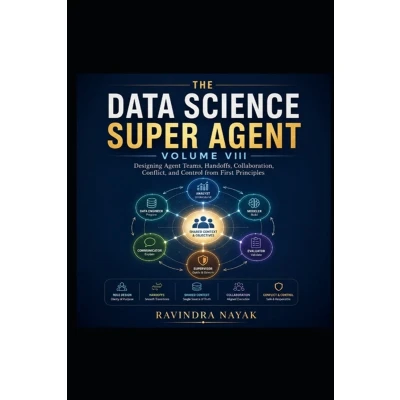
AI agents become more powerful when they stop working alone.But more agents do not automatically create more intelligence. Without clear roles, clean handoffs, shared context, conflict rules, supervision, and repair, a multi-agent system can become slower, messier, and harder to trust.The Data Science Super Agent, Volume VIII continues the first-principles journey from one responsible agentic workflow into multi-agent intelligence.This volume is for readers who understood the idea of one AI agent and now want to understand what happens when several agents must work together. It does not treat multi-agent AI as magic, hype, or a pile of advanced terminology. It teaches agent teams as responsible work design.Inside this book, you will learn how to think about: Why one agent can become overloadedWhen a task deserves multiple specialist agentsHow to define agent roles without confusionWhy every agent needs a clear boundaryHow handoffs should pass meaning, not just outputWhat shared context means in an agent teamHow private memory, shared memory, and temporary memory differWhat a supervisor agent should and should not doWhy human supervision still matters in high-impact decisionsHow to handle disagreement between agentsWhen to vote, rank, pause, retrieve more evidence, or escalateHow to evaluate an agent team beyond the final answerWhy multi-agent systems fail between agents, not only inside agentsHow to repair collaboration before adding more complexityHow to design a one-page multi-agent blueprint before choosing toolsThe book uses practical examples, calm explanations, visual learning, natural dialogue, reflection exercises, and a running retail intelligence build to help the reader see the whole system clearly.The goal is not to make the reader memorize technical language.The goal is to help the reader ask better questions: What responsibility deserves its own agent? What context must every agent share? What should remain private? What must be passed during a handoff? What happens when agents disagree? Who coordinates the team? Where does human judgment enter? How do we know the team behaved responsibly? What should be repaired before adding another agent?If Volume VII helped you see one agentic workflow, Volume VIII helps you design the team around it.This book is suitable for students, self-learners, AI-curious professionals, beginner data science readers, non-technical readers, project builders, and anyone who wants to understand AI agent teams without being buried under jargon.A multi-agent system is not powerful because many agents are talking.It becomes useful when responsibility is visible.
 Prijshistorie
 * Prijshistorie bevat geen data van Amazon, Amazon Marketplace.
Prijzen voor het laatst bijgewerkt op:
 Gerelateerde resultaten
 Productspecificaties


