

€ 82,99 Gratis verzending

Gesponsorde links
|
|
82,99 |
Naar shop
|

|
82,99 |
Naar shop
|

|
115,00 |
Naar shop
|
| VERGELIJK ALLE AANBIEDERS (3) | ||
 Beschrijving
Vergelijk aanbieders (3)
Gesponsorde links · Sommige shops betalen ons een vergoeding
€ 82,99 Gratis verzending
€ 82,99 Gratis verzending
€ 115,00 Gratis verzending
Winkels met andere maten
Beschrijving
(1)
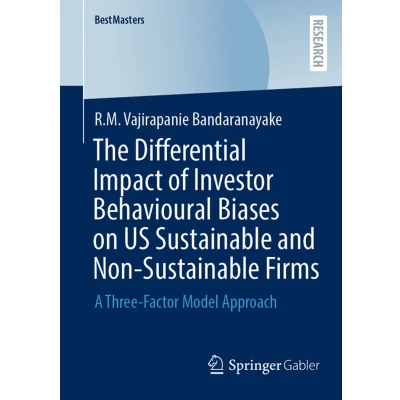
This study explores how investor behavioural biases influence sustainable (high-ESG) and non-sustainable (low-ESG) firms in the United States, using the behavioural three-factor model introduced by Daniel, Hirshleifer and Sun (2020). This study explores how investor behavioural biases influence sustainable (high-ESG) and non-sustainable (low-ESG) firms in the United States, using the behavioural three-factor model introduced by Daniel, Hirshleifer and Sun (2020). The model includes two behavioural factors: limited attention bias, which captures short-term anomalies (indicated by the Post-Earnings Announcement Drift or PEAD), and overconfidence bias, a long-term bias (as indicated by the Financing or FIN factor). By analyzing both high- and low-ESG portfolios, the study finds that both portfolios are exposed to the two biases, but the degree of exposure varies significantly. The high-ESG portfolio shows positive loadings on both behavioural factors, indicating efficient price corrections, while the low-ESG portfolio sees negative loadings. This difference in factor loadings for ESG portfolios is novel. It is likely due to arbitrage frictions. The study also finds that these biases are more pronounced during bull market phases, while they diminish in bear market phases (the overconfidence bias weakens, and the limited attention bias loses statistical significance). Furthermore, the high-ESG portfolio returns are less susceptible to overall market movements and thus offer greater downside protection during bear markets.
 Prijshistorie
* Prijshistorie bevat geen data van Amazon, Amazon Marketplace.
Prijzen voor het laatst bijgewerkt op:
 Gerelateerde resultaten
 Productspecificaties


