
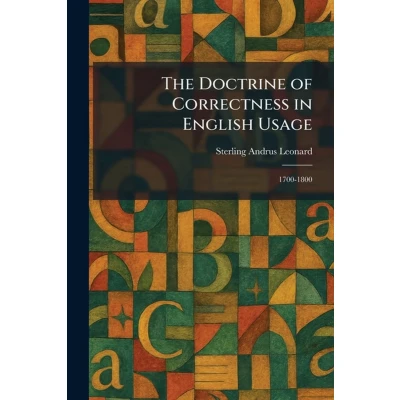
The Doctrine of Correctness in English Usage: 1700-1800
Uitgelicht

|
24,00 |
Naar shop
|

|
38,56 |
Naar shop
|
| VERGELIJK ALLE AANBIEDERS (2) | ||
 Beschrijving
Bol
"The Doctrine of Correctness in English Usage 1700-1800" is a definitive scholarly examination of the evolution of linguistic standards during a pivotal century for the English language. This work delves into the origins of prescriptive grammar, exploring how the ideals of the Enlightenment and the Age of Reason shaped the ways in which 18th-century writers, critics, and grammarians sought to codify and improve their mother tongue.Sterling Andrus Leonard provides a meticulous analysis of the theories and prejudices that governed language use during this era. The book identifies the rise of the doctrine of correctness-a movement that prioritized logic, analogy, and authority over historical usage. By examining the works of influential figures and the proliferation of grammar books and dictionaries, Leonard illuminates how the concept of a correct way to speak and write was constructed and enforced.Essential for students of linguistics, history, and rhetoric, "The Doctrine of Correctness in English Usage 1700-1800" offers invaluable insight into the cultural and intellectual forces that define modern English usage. It remains a foundational text for understanding the tensions between descriptive and prescriptive approaches to language, tracing the roots of contemporary debates back to their 18th-century foundations.This work has been selected by scholars as being culturally important, and is part of the knowledge base of civilization as we know it. This work was reproduced from the original artifact, and remains as true to the original work as possible. Therefore, you may see the original copyright references, library stamps (as most of these works have been housed in our most important libraries around the world), and other notations in the work.This work is in the public domain in the United States of America, and possibly other nations. Within the United States, you may freely copy and distribute this work, as no entity (individual or corporate) has a copyright on the body of the work.As a reproduction of a historical artifact, this work may contain missing or blurred pages, poor pictures, errant marks, etc. Scholars believe, and we concur, that this work is important enough to be preserved, reproduced, and made generally available to the public. We appreciate your support of the preservation process, and thank you for being an important part of keeping this knowledge alive and relevant.


 Beschrijving
(1)
Beschrijving
(1)
"The Doctrine of Correctness in English Usage 1700-1800" is a definitive scholarly examination of the evolution of linguistic standards during a pivotal century for the English language. This work delves into the origins of prescriptive grammar, exploring how the ideals of the Enlightenment and the Age of Reason shaped the ways in which 18th-century writers, critics, and grammarians sought to codify and improve their mother tongue.Sterling Andrus Leonard provides a meticulous analysis of the theories and prejudices that governed language use during this era. The book identifies the rise of the doctrine of correctness-a movement that prioritized logic, analogy, and authority over historical usage. By examining the works of influential figures and the proliferation of grammar books and dictionaries, Leonard illuminates how the concept of a correct way to speak and write was constructed and enforced.Essential for students of linguistics, history, and rhetoric, "The Doctrine of Correctness in English Usage 1700-1800" offers invaluable insight into the cultural and intellectual forces that define modern English usage. It remains a foundational text for understanding the tensions between descriptive and prescriptive approaches to language, tracing the roots of contemporary debates back to their 18th-century foundations.This work has been selected by scholars as being culturally important, and is part of the knowledge base of civilization as we know it. This work was reproduced from the original artifact, and remains as true to the original work as possible. Therefore, you may see the original copyright references, library stamps (as most of these works have been housed in our most important libraries around the world), and other notations in the work.This work is in the public domain in the United States of America, and possibly other nations. Within the United States, you may freely copy and distribute this work, as no entity (individual or corporate) has a copyright on the body of the work.As a reproduction of a historical artifact, this work may contain missing or blurred pages, poor pictures, errant marks, etc. Scholars believe, and we concur, that this work is important enough to be preserved, reproduced, and made generally available to the public. We appreciate your support of the preservation process, and thank you for being an important part of keeping this knowledge alive and relevant.
 Productspecificaties
 Prijshistorie
* Prijshistorie bevat geen data van Amazon.
Prijzen voor het laatst bijgewerkt op:
 Gerelateerde resultaten


