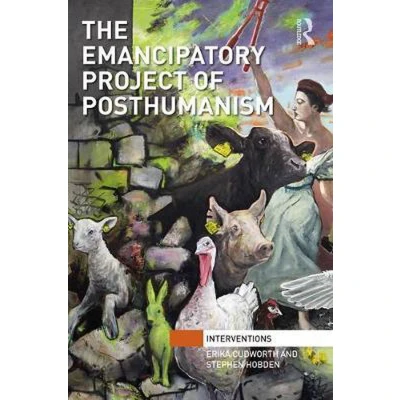

The Emancipatory Project of Posthumanism

Prijzen vanaf
58,99

Uitgelicht

VERGELIJK ALLE AANBIEDERS (2)

Beschrijving

Bol Partner This book defines a posthuman approach as one that has a starting point in complexity thinking, promotes a non-Newtonian approach to the study of the social world, and advocates a non-anthropocentric perspective, considering various interpretations of the term 'emancipation.’ This is the first book to make the argument for an emancipatory project from within a posthuman framework. Responding to critics, Cudworth and Hobden argue that while some posthumanisms may be less critical, it is possible to develop a political programme from a posthuman perspective. Cudworth and Hobden develop such issues by addressing the following questions: How have ideas about emancipation been developed, and does the notion of emancipation still hold relevance for the contemporary world order? Is it possible to have a non-Utopian form of emancipation? What are the implications of differing posthuman/new materialist viewpoints for an emancipatory project? In a world typified by complexity, how is it possible to pursue political projects? The chapters consider various interpretations of the term ‘emancipation’, looking at work that has appeared within the posthumanist framework such as Bruno Latour, William Connolly, and Jane Bennett. The authors develop their own account of posthumanism, demonstrating how it avoids the problems that have been found within this framework, and considering the possibilities for emancipatory projects and public policy. It will be of great interest to postgraduates and scholars of International Relations, Political Theory, Environmental Studies, and Sociology.

Vergelijk aanbieders (2)

Shop
Prijs
Verzendkosten
Totale prijs
58,99
Gratis
58,99
Naar shop
Gratis Shipping Costs
108,95
gebruikt
Gratis
108,95
Naar shop
Gratis Shipping Costs
Beschrijving (2)
Bol Partner

This book defines a posthuman approach as one that has a starting point in complexity thinking, promotes a non-Newtonian approach to the study of the social world, and advocates a non-anthropocentric perspective, considering various interpretations of the term 'emancipation.’ This is the first book to make the argument for an emancipatory project from within a posthuman framework. Responding to critics, Cudworth and Hobden argue that while some posthumanisms may be less critical, it is possible to develop a political programme from a posthuman perspective. Cudworth and Hobden develop such issues by addressing the following questions: How have ideas about emancipation been developed, and does the notion of emancipation still hold relevance for the contemporary world order? Is it possible to have a non-Utopian form of emancipation? What are the implications of differing posthuman/new materialist viewpoints for an emancipatory project? In a world typified by complexity, how is it possible to pursue political projects? The chapters consider various interpretations of the term ‘emancipation’, looking at work that has appeared within the posthumanist framework such as Bruno Latour, William Connolly, and Jane Bennett. The authors develop their own account of posthumanism, demonstrating how it avoids the problems that have been found within this framework, and considering the possibilities for emancipatory projects and public policy. It will be of great interest to postgraduates and scholars of International Relations, Political Theory, Environmental Studies, and Sociology.

Bol

This is the first book to make the argument for an emancipatory project from within a posthuman framework. Responding to critics, Cudworth and Hobden argue that while some posthumanisms may be less critical, it is possible to develop a political programme from a posthuman perspective. Cudworth and Hobden develop such issues by addressing the following questions: How have ideas about emancipation been developed, and does the notion of emancipation still hold relevance for the contemporary world order? Is it possible to have a non-Utopian form of emancipation? What are the implications of differing posthuman/new materialist viewpoints for an emancipatory project? In a world typified by complexity, how is it possible to pursue political projects? The chapters consider various interpretations of the term ‘emancipation’, looking at work that has appeared within the posthumanist framework such as Bruno Latour, William Connolly, and Jane Bennett. The authors develop their own account of posthumanism, demonstrating how it avoids the problems that have been found within this framework, and considering the possibilities for emancipatory projects and public policy. It will be of great interest to postgraduates and scholars of International Relations, Political Theory, Environmental Studies, and Sociology.


Productspecificaties

EAN
  • 9781317203223
  • 9781138673250
Maat


Prijshistorie

Prijzen voor het laatst bijgewerkt op:

Uitgelichte Keuze
58,99
Naar shop
