

€ 52,01 Gratis verzending

Gesponsorde links
|
|
52,01 |
Naar shop
|

|
52,01 |
Naar shop
|

|
79,99 |
Naar shop
|
| VERGELIJK ALLE AANBIEDERS (3) | ||
 Beschrijving
Vergelijk aanbieders (3)
Gesponsorde links · Sommige shops betalen ons een vergoeding
€ 52,01 Gratis verzending
€ 52,01 Gratis verzending
€ 79,99 Gratis verzending
Winkels met andere maten
Beschrijving
(1)
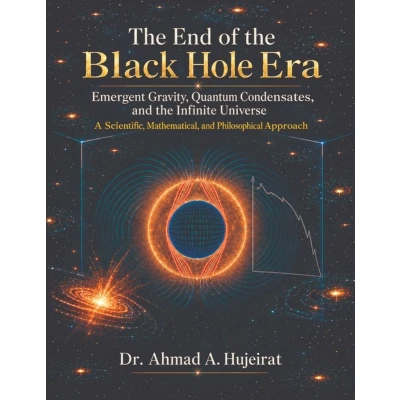
The standard framework of black holes admits the possibility of infinite density, yet largely excludes the possibility of a finite universal maximum density. Likewise, it accommodates both attractive gravity and effective gravitational repulsion, while leaving little room for an intermediate, gravitationally neutral state.Based on mathematical and physical considerations, combined with observations of glitching pulsars and neutron-star-black-hole mergers, I critically examine the foundations of black-hole theory and guide the reader toward a new, nonsingular, and physically viable alternative, where general relativity meets quantum field theory.The analysis proceeds through quantum holography, asymptotic freedom in quantum chromodynamics, and the incompressibility of supranuclear-dense, ultra-cold matter, leading to a new state of matter that was unknown to Newton, Einstein, and Schwarzschild.The book provides a basis for discussing key open questions in astrophysics and cosmology, including cosmic inflation, dark matter, dark energy, the Hubble tension, and the large-scale flatness of spacetime, as well as why, on such scales, the distinction between geocentric and heliocentric descriptions becomes physically irrelevant. Finally, the last chapter is devoted to a discussion of creatio ex nihilo and the parent universe, as well as the origin of mathematics and its unreasonable effectiveness, arguing thereby that mathematics is invented rather than discovered in a Platonic realm.
 Prijshistorie
* Prijshistorie bevat geen data van Amazon, Amazon Marketplace.
Prijzen voor het laatst bijgewerkt op:
 Gerelateerde resultaten
 Productspecificaties


