


€ 225,00 Gratis verzending

Gesponsorde links
|
|
225,00 |
Naar shop
|

|
267,50 |
Naar shop
|
| VERGELIJK ALLE AANBIEDERS (2) | ||
 Beschrijving
Vergelijk aanbieders (2)
Gesponsorde links · Sommige shops betalen ons een vergoeding
€ 225,00 Gratis verzending
€ 267,50 Gratis verzending
Winkels met andere maten
Beschrijving
(1)
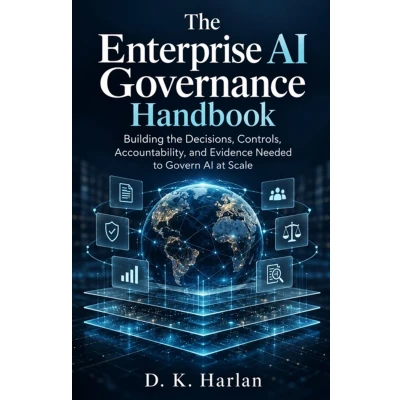
AI governance becomes real when someone has to decide what an AI system may do.Artificial intelligence is entering enterprises through generative AI tools, purchased software, embedded features, internal models, APIs and increasingly autonomous agents. The challenge is no longer simply whether organizations should use AI. It is determining what AI may do, which data it may access, who has authority to approve it, what controls must constrain it and what evidence must exist when decisions are questioned.The Enterprise AI Governance Handbook provides a practical operating model for governing AI at scale.D. K. Harlan shows how organizations can move from principles and policies to actual decisions, permissions, controls, accountability and evidence.Readers will learn how to build an enterprise AI inventory, classify uses according to consequence and autonomy, assign decision rights, govern human oversight, establish approval requirements, manage vendors and third-party models, control agentic AI, define evidence requirements, handle incidents and material changes, monitor systems after deployment and retire them responsibly.The book addresses a central problem in enterprise governance: documentation is not the same as control.A control changes what can happen. Evidence establishes what did happen.Designed for business leaders, AI governance teams, risk and compliance professionals, legal and privacy functions, security leaders, auditors, procurement teams, technologists and system owners, this handbook provides a repeatable architecture for governing AI without forcing every use through the same process.See the AI. Classify the consequence. Assign the authority. Require the evidence. Govern the decision.
 Prijshistorie
* Prijshistorie bevat geen data van Amazon.
Prijzen voor het laatst bijgewerkt op:
 Gerelateerde resultaten
 Productspecificaties


