

€ 21,99 Gratis verzending

Uitgelicht
|
|
21,99 |
Naar shop
|

|
21,99 |
Naar shop
|

|
24,99 |
Naar shop
|
| VERGELIJK ALLE AANBIEDERS (3) | ||
 Beschrijving
Vergelijk aanbieders (3)
€ 21,99 Gratis verzending
€ 21,99 Gratis verzending
€ 24,99 € 2,99 verzendkosten Totaal € 27,98
Winkels met andere maten
Beschrijving
(1)
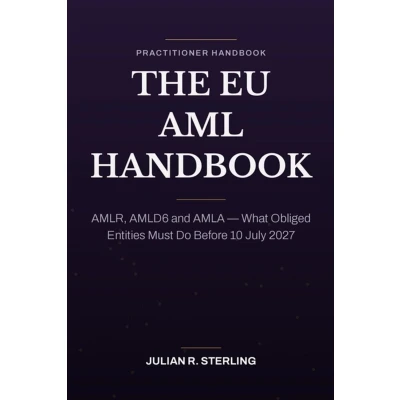
One date governs this book: 10 July 2027.On that morning, Regulation (EU) 2024/1624 - the Anti-Money Laundering Regulation - becomes directly applicable across the European Union, and Directive (EU) 2015/849, the rulebook compliance functions have built around for a decade, is repealed with effect from the same day. National goldplating falls away. So do national derogations that some firms have quietly relied on. The following year, the new Anti-Money Laundering Authority begins direct supervision of the largest cross-border groups.Most commentary on the package explains the politics. The EU AML Handbook is a build plan with a date on it.What it covers- Entity-by-entity scoping against the Article 3 list, including the newly or differently caught heads: crypto-asset services, crowdfunding, credit intermediation, investment migration, high-value goods, letting above 10,000 euro monthly rent- The two statutory roles created by Article 11, and the paperwork that proves they exist- Internal policies, procedures and controls, and the split approval standard firms get wrong- The business-wide risk assessment, and who drafts and who approves it- Customer due diligence rebuilt from the trigger list up, including the both-parties rule for real estate- Beneficial ownership, and the arithmetic of indirect holdings across chains- Registers and legitimate interest after the end of general public access- Enhanced due diligence, politically exposed persons, high-risk third countries and the new high-net-worth regime- Reporting, records and tipping off; outsourcing, groups and third countries- The data and systems build, treated as the engineering problem it is- The back book of existing customers, sanctions and enforcement floors, and what is still nationalWhy it is usable under time pressure- It distinguishes on every page between settled law, draft technical standard and national discretion - because a programme built on a draft that nobody flagged as draft is how transitions fail.- It is sequenced by dependency rather than by topic, ending in a dated eleven-month plan with four phases, owners, deliverables and checkpoints.- Its appendices are built to be lifted into a working document: an article map, a gap analysis template, a specification of what the board pack must contain, a forty-question scored readiness assessment, and a glossary.Who it is forMoney laundering reporting officers, compliance officers, financial crime team leads, group heads of financial crime, and the advisers who support them - in the European Union, and in UK and international firms with EU operations.This book states the position as at 1 August 2026. It is a practitioner's reference, not legal advice.Written for the person who has to make the organisation ready.
 Prijshistorie
 * Prijshistorie bevat geen data van Amazon, Amazon Marketplace.
Prijzen voor het laatst bijgewerkt op:
 Gerelateerde resultaten
 Productspecificaties


