
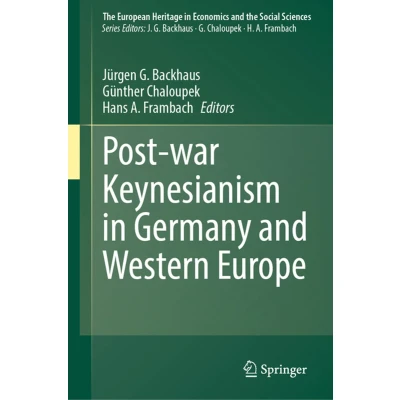
the European Heritage in Economics and Social Sciences28 Post war Keynesianism Germany Western Europe
Uitgelicht

|
175,00 |
Naar shop
|
| VERGELIJK ALLE AANBIEDERS (1) | ||
 Beschrijving
Bol
and the relevance of Keynesian ideas in Austria and Norway. Providing a survey of important theoretical economists in post-war Germany, this volume will be of interest to researchers and students of economic policy, contemporary political, social and economic systems, history of economic thought and political history. This edited volume discusses the reception and application of Keynesian economics in Europe during the 20th century. The main focus of the book is the case of West Germany, where the strong position of Keynesian economics (primarily of the neoclassical synthesis type) at most universities since the 1950s contrasted with Ordoliberalism and the concept of the Social Market Economy, which became dominant German economic policy after the war. Chapter contributions focus on important pioneers of theoretical or political Keynesianism, such as Erich Schneider, Andreas Paulsen, and Karl Schiller in Germany, Kurt Rothschild in Austria, Gottfried Bombach in Switzerland; the influence of Keynes on other economists; and the relevance of Keynesian ideas in Austria and Norway. Providing a survey of important theoretical economists in post-war Germany, this volume will be of interest to researchers and students of economic policy, contemporary political, social and economic systems, history of economic thought and political history. This edited volume discusses the reception and application of Keynesian economics in Europe during the 20th century. The main focus of the book is the case of West Germany, where the strong position of Keynesian economics (primarily of the neoclassical synthesis type) at most universities since the 1950s contrasted with Ordoliberalism and the concept of the Social Market Economy, which became dominant German economic policy after the war. Chapter contributions focus on important pioneers of theoretical or political Keynesianism, such as Erich Schneider, Andreas Paulsen, and Karl Schiller in Germany, Kurt Rothschild in Austria, Gottfried Bombach in Switzerland; the influence of Keynes on other economists; and the relevance of Keynesian ideas in Austria and Norway. Providing a survey of important theoretical economists in post-war Germany, this volume will be of interest to researchers and students of economic policy, contemporary political, social and economic systems, history of economic thought and political history.


Vergelijk aanbieders (1)

 Beschrijving
(1)
Beschrijving
(1)
and the relevance of Keynesian ideas in Austria and Norway. Providing a survey of important theoretical economists in post-war Germany, this volume will be of interest to researchers and students of economic policy, contemporary political, social and economic systems, history of economic thought and political history. This edited volume discusses the reception and application of Keynesian economics in Europe during the 20th century. The main focus of the book is the case of West Germany, where the strong position of Keynesian economics (primarily of the neoclassical synthesis type) at most universities since the 1950s contrasted with Ordoliberalism and the concept of the Social Market Economy, which became dominant German economic policy after the war. Chapter contributions focus on important pioneers of theoretical or political Keynesianism, such as Erich Schneider, Andreas Paulsen, and Karl Schiller in Germany, Kurt Rothschild in Austria, Gottfried Bombach in Switzerland; the influence of Keynes on other economists; and the relevance of Keynesian ideas in Austria and Norway. Providing a survey of important theoretical economists in post-war Germany, this volume will be of interest to researchers and students of economic policy, contemporary political, social and economic systems, history of economic thought and political history. This edited volume discusses the reception and application of Keynesian economics in Europe during the 20th century. The main focus of the book is the case of West Germany, where the strong position of Keynesian economics (primarily of the neoclassical synthesis type) at most universities since the 1950s contrasted with Ordoliberalism and the concept of the Social Market Economy, which became dominant German economic policy after the war. Chapter contributions focus on important pioneers of theoretical or political Keynesianism, such as Erich Schneider, Andreas Paulsen, and Karl Schiller in Germany, Kurt Rothschild in Austria, Gottfried Bombach in Switzerland; the influence of Keynes on other economists; and the relevance of Keynesian ideas in Austria and Norway. Providing a survey of important theoretical economists in post-war Germany, this volume will be of interest to researchers and students of economic policy, contemporary political, social and economic systems, history of economic thought and political history.
 Productspecificaties
| EAN |
|
|---|---|
| Maat |
|
 Prijshistorie
Prijzen voor het laatst bijgewerkt op:
 Gerelateerde resultaten


