


€ 90,24 Gratis verzending

Uitgelicht
|
|
90,24 |
Naar shop
|
| VERGELIJK ALLE AANBIEDERS (1) | ||
 Beschrijving
Vergelijk aanbieders (1)
€ 90,24 Gratis verzending
Winkels met andere maten
Beschrijving
(1)
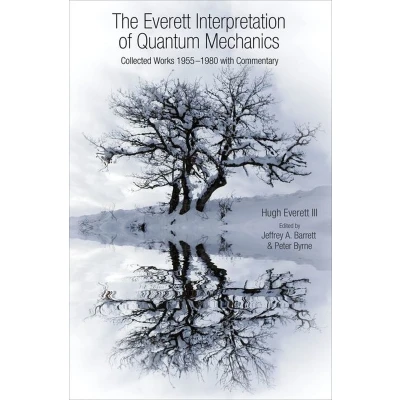
Hugh Everett III was an American physicist best known for his many-worlds interpretation of quantum mechanics, which formed the basis of his PhD thesis at Princeton University in 1957. Although counterintuitive, Everett's revolutionary formulation of quantum mechanics offers the most direct solution to the infamous quantum measurement problem--that is, how and why the singular world of our experience emerges from the multiplicities of alternatives available in the quantum world. The many-worlds interpretation postulates the existence of multiple universes. Whenever a measurement-like interaction occurs, the universe branches into relative states, one for each possible outcome of the measurement, and the world in which we find ourselves is but one of these many, but equally real, possibilities. Everett's challenge to the orthodox interpretation of quantum mechanics was met with scorn from Niels Bohr and other leading physicists, and Everett subsequently abandoned academia to conduct military operations research. Today, however, Everett's formulation of quantum mechanics is widely recognized as one of the most controversial but promising physical theories of the last century. In this book, Jeffrey Barrett and Peter Byrne present the long and short versions of Everett's thesis along with a collection of his explanatory writings and correspondence. These primary source documents, many of them newly discovered and most unpublished until now, reveal how Everett's thinking evolved from his days as a graduate student to his untimely death in 1982. This definitive volume also features Barrett and Byrne's introductory essays, notes, and commentary that put Everett's extraordinary theory into historical and scientific perspective and discuss the puzzles that still remain.
 Productspecificaties
| EAN |
|
|---|---|
| Maat |
|
 Prijshistorie
 Prijzen voor het laatst bijgewerkt op:
 Gerelateerde resultaten


