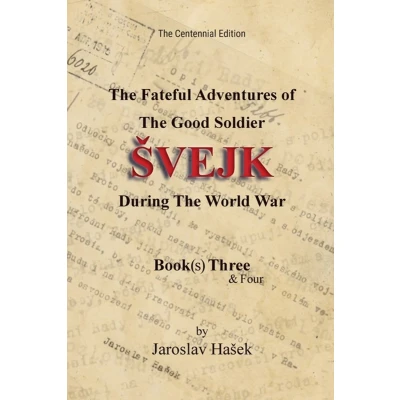


€ 18,74 Gratis verzending

Uitgelicht
|
|
18,74 |
Naar shop
|

|
18,74 |
Naar shop
|

|
24,95 |
Naar shop
|
| VERGELIJK ALLE AANBIEDERS (3) | ||
 Beschrijving
Vergelijk aanbieders (3)
€ 18,74 Gratis verzending
€ 18,74 Gratis verzending
€ 24,95 € 2,99 verzendkosten Totaal € 27,94
Winkels met andere maten
Beschrijving
(1)
In Book(s) Three & Four of The Fateful Adventures of the Good Soldier ¿vejk, the novel enters its final and most uncompromising phase. After the detours, misidentifications, and bureaucratic farces of the earlier volumes, the system closes in. ¿vejk, now absorbed into the military machine, is dispatched toward the front-yet never fully assimilated. Assigned as servant to an anxious officer and carried forward by transport and march, he moves through a world governed by interrogation, diagnosis, and command.What began in Book One as a parade of social types and in Book Two as a logic of displacement now hardens into a logic of prosecution. Officers interrogate. Doctors diagnose. Priests admonish. Every word ¿vejk speaks becomes potential evidence-for or against him. A misplaced phrase, a wrong turn, an ill-timed joke, or even silence itself may be read as guilt. Authority no longer seeks understanding; it seeks confirmation.In these final books, Ha¿ek's structural irony reaches its fullest expression. Institutions devour meaning. Testimony collapses under its own accumulation. ¿vejk survives neither by confession nor denial, but by offering endless statements that parody the very idea of judgment. He becomes at once the accused, the witness, and the interpreter of his own trial, exposing the absurdity of a system that can no longer distinguish sense from procedure.Book(s) Three & Four contain the darkest and most revealing chapters of Ha¿ek's unfinished epic. Though the author's death halted the narrative, it did not arrest its direction. The novel's diagnostic language completes its descent-from the clinical to the vernacular-not in a verdict, but in the breakdown of the official story itself.This volume concludes with the words of the final paragraph Ha¿ek dictated before his death-previously misattributed, now correctly credited to Ha¿ek and restored to their proper place in the novel, and here published for the first time in any language-bringing the work to an ending that is historically grounded, structurally coherent, and unresolved.The Centennial Edition includes extensive analytical apparatus, among itFranti¿ek Josef and the Grammar of Czech Subjecthood in Ha¿ek's Opening Line and ¿vejk on Trial: Rethinking Ha¿ek's Novel as a Pendulum of Prosecution and Defense.An additional companion essay, Svejkardom: Recognition, Survival, and the Grammar of a World, extends this interpretive framework online at svejkcentral.com/Analyses.Together these translator-authored texts examine how Czech morphosyntax, procedural language, and the experiential concept ¿vejkárna (svejkardom) shape contemporary readings of Ha¿ek's novel.
 Prijshistorie
 * Prijshistorie bevat geen data van Amazon, Amazon Marketplace.
Prijzen voor het laatst bijgewerkt op:
 Gerelateerde resultaten
 Productspecificaties


