
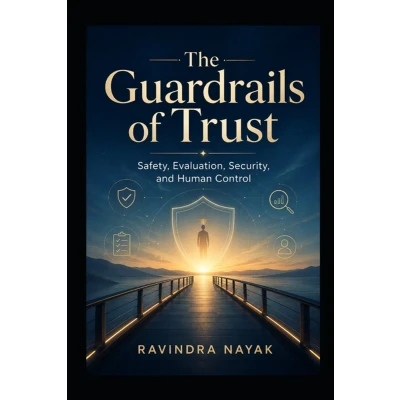
The Guardrails of Trust: Safety, Evaluation, Security, and Human Control
Uitgelicht

|
12,83 |
Naar shop
|

|
12,83 |
Naar shop
|

|
13,50 |
Naar shop
|
| VERGELIJK ALLE AANBIEDERS (3) | ||
 Beschrijving
Bol
An AI agent can finish a task in seconds-and still fail the people the task was meant to serve. Speed, fluency, and automation can create the appearance of intelligence before they create dependable work. A polished answer may be unsupported. A helpful tool may have too much access. A high accuracy score may hide the wrong kind of error. A human approval button may exist without giving anyone the time, evidence, or authority to make a meaningful decision. The Guardrails of Trust gives non-technical readers a clear, practical way to question AI systems without fearing them or trusting them blindly. Beginning with familiar workplace situations, Ravindra Nayak explains how trust is built from visible parts: purpose, evidence, permissions, test cases, approval gates, monitoring, recovery, and accountable human judgment. Technical ideas are introduced only after their human meaning is clear. Mathematics becomes a lantern rather than a barrier, helping readers understand accuracy, precision, recall, false positives, false negatives, thresholds, failure probability, confidence, and the cost of error through intuitive examples. Inside this book, readers will learn how to: - distinguish an impressive demonstration from dependable everyday performance;- design realistic test cases and benchmarks for workplace AI agents;- recognize hallucination, prompt injection, data leakage, excessive permissions, and hidden control debt;- understand audit trails, traces, observability, red teaming, incident response, rollback, and emergency stopping rules;- evaluate fairness, uncertainty, and the human consequences of different mistakes;- place human review where it can genuinely change what happens next;- create a complete trust and evaluation plan for an AI-enabled workplace system.The journey unfolds through the Common Ground Workshop, where ordinary professionals face urgent requests, uncertain evidence, security boundaries, near misses, appeals, and difficult release decisions. Their dialogues make complex ideas memorable and show that responsible AI is not a technical department's private concern. Managers, employees, educators, students, risk teams, operations leaders, and curious readers all have a role in asking better questions. This is not a book about stopping innovation. It is about creating dependable freedom: allowing useful systems to act within limits that people can understand, supervise, challenge, and improve. By the final page, readers will be able to move beyond vague trust and say, with confidence: I know how to question, test, supervise, and improve an AI system instead of trusting it blindly.


 Beschrijving
(1)
Beschrijving
(1)
An AI agent can finish a task in seconds-and still fail the people the task was meant to serve. Speed, fluency, and automation can create the appearance of intelligence before they create dependable work. A polished answer may be unsupported. A helpful tool may have too much access. A high accuracy score may hide the wrong kind of error. A human approval button may exist without giving anyone the time, evidence, or authority to make a meaningful decision. The Guardrails of Trust gives non-technical readers a clear, practical way to question AI systems without fearing them or trusting them blindly. Beginning with familiar workplace situations, Ravindra Nayak explains how trust is built from visible parts: purpose, evidence, permissions, test cases, approval gates, monitoring, recovery, and accountable human judgment. Technical ideas are introduced only after their human meaning is clear. Mathematics becomes a lantern rather than a barrier, helping readers understand accuracy, precision, recall, false positives, false negatives, thresholds, failure probability, confidence, and the cost of error through intuitive examples. Inside this book, readers will learn how to: - distinguish an impressive demonstration from dependable everyday performance;- design realistic test cases and benchmarks for workplace AI agents;- recognize hallucination, prompt injection, data leakage, excessive permissions, and hidden control debt;- understand audit trails, traces, observability, red teaming, incident response, rollback, and emergency stopping rules;- evaluate fairness, uncertainty, and the human consequences of different mistakes;- place human review where it can genuinely change what happens next;- create a complete trust and evaluation plan for an AI-enabled workplace system.The journey unfolds through the Common Ground Workshop, where ordinary professionals face urgent requests, uncertain evidence, security boundaries, near misses, appeals, and difficult release decisions. Their dialogues make complex ideas memorable and show that responsible AI is not a technical department's private concern. Managers, employees, educators, students, risk teams, operations leaders, and curious readers all have a role in asking better questions. This is not a book about stopping innovation. It is about creating dependable freedom: allowing useful systems to act within limits that people can understand, supervise, challenge, and improve. By the final page, readers will be able to move beyond vague trust and say, with confidence: I know how to question, test, supervise, and improve an AI system instead of trusting it blindly.
 Productspecificaties
 Prijshistorie
* Prijshistorie bevat geen data van Amazon, Amazon Marketplace.
Prijzen voor het laatst bijgewerkt op:
 Gerelateerde resultaten


