
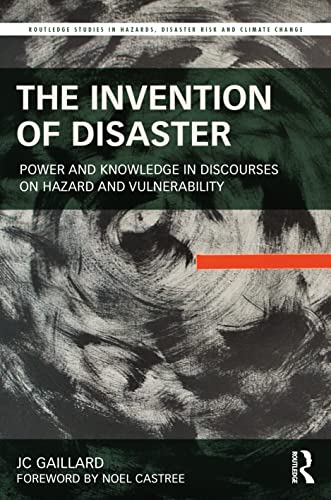
The Invention of Disaster: Power and Knowledge in Discourses on Hazard Vulnerability
Prijzen vanaf
51,66

Uitgelicht

VERGELIJK ALLE AANBIEDERS (3)

Beschrijving

Bol This book argues that the domination of Western knowledge in disaster scholarship has allowed for normative policies and practices of disaster risk reduction to be imposed all over the world. It takes a postcolonial approach to deconstruct concepts, methods, and forms of governments inherited from the Enlightenment. This theoretical contribution argues that the domination of Western knowledge in disaster scholarship has allowed normative policies and practices of disaster risk reduction to be imposed all over the world. It takes a postcolonial approach to unpack why scholars claim that disasters are social constructs while offering little but theories, concepts and methods supposed to be universal in understanding the unique and diverse experiences of millions of people across very different cultures. It further challenges forms of governments inherited from the Enlightenment that have been rolled out as standard and ultimate solutions to reduce the risk of disaster. Ultimately, the book encourages the emergence of a more diverse set of world views/senses and ways of knowing for both studying disasters and informing policy and practice of disaster risk reduction. Such pluralism is essential to better reflect local realities of what disasters actually are around the world. This book is an essential read for scholars and postgraduate students interested in disaster studies as well as policy-makers and practitioners of disaster risk reduction.

Vergelijk aanbieders (3)

Shop
Prijs
Verzendkosten
Totale prijs
51,66
Gratis
51,66
Naar shop
Gratis Shipping Costs
51,66
Gratis
51,66
Naar shop
Gratis Shipping Costs
52,33
Gratis
52,33
Naar shop
Gratis Shipping Costs
Beschrijving (2)
Bol

This book argues that the domination of Western knowledge in disaster scholarship has allowed for normative policies and practices of disaster risk reduction to be imposed all over the world. It takes a postcolonial approach to deconstruct concepts, methods, and forms of governments inherited from the Enlightenment. This theoretical contribution argues that the domination of Western knowledge in disaster scholarship has allowed normative policies and practices of disaster risk reduction to be imposed all over the world. It takes a postcolonial approach to unpack why scholars claim that disasters are social constructs while offering little but theories, concepts and methods supposed to be universal in understanding the unique and diverse experiences of millions of people across very different cultures. It further challenges forms of governments inherited from the Enlightenment that have been rolled out as standard and ultimate solutions to reduce the risk of disaster. Ultimately, the book encourages the emergence of a more diverse set of world views/senses and ways of knowing for both studying disasters and informing policy and practice of disaster risk reduction. Such pluralism is essential to better reflect local realities of what disasters actually are around the world. This book is an essential read for scholars and postgraduate students interested in disaster studies as well as policy-makers and practitioners of disaster risk reduction.

Amazon

Pagina's: 252, Editie: Eerste editie, Paperback, Routledge


Productspecificaties

Merk Routledge
EAN
  • 9781032162720
Maat


Prijshistorie

* Prijshistorie bevat geen data van Amazon, Amazon Marketplace.

Prijzen voor het laatst bijgewerkt op:

Uitgelichte Keuze
51,66
Naar shop