


€ 12,00 € 2,99 verzendkosten Totaal € 14,99

Uitgelicht
|
|
12,00 |
Naar shop
|

|
27,88 |
Naar shop
|
| VERGELIJK ALLE AANBIEDERS (2) | ||
 Beschrijving
Vergelijk aanbieders (2)
€ 12,00 € 2,99 verzendkosten Totaal € 14,99
gebruikt € 27,88 Gratis verzending
Winkels met andere maten
Beschrijving
(1)
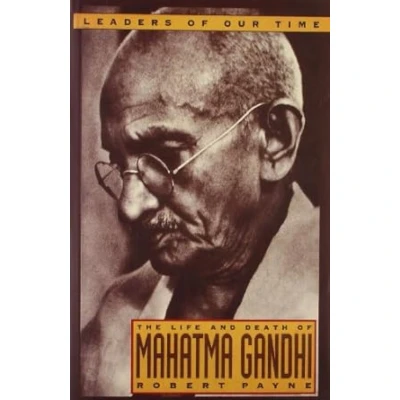
This is the heroic story of the man whose non-violent movement transformed his native India both spiritually and politically as it impelled the nation along the road to independence. With consummate skill, in a narration that never flags in vividness and drama, Robert Payne recreates Mahatma Gandhi both as a spiritual and historical force and as a living personality. When in January, 1948, Gandhi was assassinated in Delhi by a fanatic, his death sent shock waves around the world. For two generations he had been the conscience of his country and the world. Planting the idea of non-violence firmly in men's minds, he had not only conquered India but also changed the lande scape of the human heart. Robert Payne superbly describes Gandhi's daring marches to aid the oppressed; his fasts and imprisonments; his historic achievements at international congresses and conferences in India and England where, clad only in shawl and loincloth, he met with prime ministers and viceroys and won their respect as he fought for the dignity and freedom of his people. Robert Payne devotes special attention to Gandhi's friendships with other great figures such as Rajchandra, Tagore, Gokhale, Romain.Rolland, and many others. The plot that led to the murder of this saintly man, and the movements of the assassins in the days before the tragedy, are fully probed for the first time in these pages. ABOUT THE AUTHOR Born in 1911 in Cornwall, England, Robert Payne lived in Europe, Asia and Africa before making his home in New York City. Among his 100 books published are such distinguished titles as 7he Life and Death of Lenin and The Gold of Troy, both Book-of-the-Month-Club selections; Zhe Rise and Fall of Stalin, The Life and Death of Adolf Hitler, The Dream and the Tomb: A History of the Crusades, and Forever China. Mr. Payne cultivated a vast range of literary and historical interests. Wrote Orville Prescott as daily book critic of The New York Times: “Mr. Payne is a literary phenomenon of astounding industry and versatility.” LEADERS OF OUR TIME WINSTON CHURCHILL: AN INTIMATE PORTRAIT by Violet Bonham Carter THE LIFE AND DEATH OF MAHATMA GANDHI by Robert Payne BEFORE THE TRUMPET: YOUNG FRANKLIN ROOSEVELT by Geoffrey C. Ward JOSEPH STALIN: MAN & LEGEND by Ronald Hingley Jacket design by Cindy LaBreacht IN THE FOLLOWING pages I have sought to draw a rounded portrait of Mohandas Karamchand Gandhi, the son of a high official in an obscure princelv court, who received from the poet Rabindranath Tagore the title of Mahatma. I especially wanted to see him striding vigorously along the dusty roads of South Africa and India, and to be close enough to him, when he was among his companions or waging war against his enemies, to watch the changing expression of his eyes and the movement of his thought. I wanted to see him in those unguarded moments when men reveal most about themselves. There was much to be said for stripping away the legends that have accumulated around him and seeing him plain. He was a man who lived in public throughout the greater part of his life, eating, sleeping, bathing, thinking, writing and dreaming in full view of everyone who stayed in his ashram or accompanied him on his journeys, but such men have their own ways of concealing themselves. He wore many public masks and many private ones, and sometimes, like all men, he mislaid the masks and showed himself naked. Also, he was sometimes mischievous, and what seemed to be a mask was often his own face smiling with amusement because he had outwitted the observer. Sarojini Naidu, that glorious mountain of a woman, used to call him “our Mickey Mouse,” and it would be a mistake to underestimate that quality in him. Others proclaimed him to be a Messiah, half-brother to Buddha or Christ, possessing divine attributes, wholly self less and devoting his life to the good of humanity. Those who believed this would kneel before him and touch his feet, or wait for days at a railroad station in the hope of catching a glimpse of him as his train passed in the night. The truth, of course, is that he was variable, and was sometimes Mickey Mouse, some. times a Messiah speaking with tongucs of flame. He acted many roles, and never wearied of his performances. Since he played these changing roles so well, he was sometimes accused of being a virtuoso performer with extraordinary powers of improvisation. In fact, he was the author of the play, the stage manager and most of the players. In our own age there have been two authentic political geniuses, Lenin and Gandhi. They left their stamp on history in such a way that it is likely that they will be remembered a thousand years from now, when all the other captains have been forgotten. They were both men who created revolutions single-handed, but while one was determined upon violent revolution, the other, employing peaceful weapons, was determined upon creation. One took vengeance on the human race, the other loved it. Gandhi showed that non-violent resistance was at least as powerful as guns; and he opened the way for more enduring conquests. Through him men have learned that no government, even the most tyrannical, is immune from non-violent resistance in the hands of determined and fearless men. No power on earth can resist the aroused consciences of men once they are disciplined and prepared to die for their beliefs. Gandhi was prepared to die: this was his most powerful weapon. All his life he threw himself into battle with the vigor of a young athlete. Ironically, the man who celebrated non-violence and first employed it on a nationwide scale, possessed a heroic temper and enjoyed nothing more than being in the midst of battle. “I love storms,” he said once, and he was never comfortable unless the lightning was playing and the thunder was roaring in his ears. The storms gathered at the end of his life, and he saw most of his dreams shattered. A few months before his death he watched India being torn apart into two bleeding fragments, and he may have known that his fight for Hindu-Muslim unity was doomed to failure. The agony of his last days was terrible to watch: to the very end he struggled against the partition of his country. Yet he had set the wheel in motion, and his triumphs were at least as memorable as his failures. He brought freedom and independence to India and he changed men’s minds. Most of the men who have profoundly affected history have possessed one-track minds: they have one aim, and spend their energies in obtaining it. Gandhi's aims were various. His private aim was to see God face to face; he would capture Heaven by storm. His public aim was to topple the British Raj and to bring about the freedom and independence of India, and at the same time he wanted to bring about a transformation of Indian society to make her more worthy of her freedom. In his eyes it was not enough to be a revolutionary. He must be a theologian, a devoted follower of Krishna, a lam given, student of village life, sanitary engineer, authority on dietetaes, doetor, defender of the untouchables, plenipotentiary, peacemaker, salt gatherer. At the height of his fame and influence he enjoyed cleamng out latrines. When he was very old, he wandered almost alone mto terntory where men were murdering one another, offering himself as a simple sacrifice, But simplicity escaped him, and when he was shot down, he was no longer a man but a legend so much larger than life that it was as though a whole army or a whole nation had perished. Because he was so various and became so legendary, I have studied his early vears at considerable length. So there is a good deal here about his bovhood and upbringing at Porbandar and Rajkot, and his first hardfought campaigns in South Africa which prepared him for his campaigns in India. 1 have also discussed the circumstances of the assassination at length, and 1 have shown that this too was not quite so simple as it seemed to be. 1 have made no attempt to conceal the dark side of his nature, the thin black threads winding among the many-colored ribbons of hís life. He was a bad father, a tyrant to his followers, and rarely made any effort to conceal the authoritarian streak he had inherited from his ancestors. He was fascinated by sex to the point of obsession, and long after he had taken a formal vow of chastity he would share his bed with women, saying that all animal passion had died in him and therefore he was behaving with perfect purity. Sometimes he believed in his own mahatmaship, and this was perhaps the most dangerous of all his beliefs. From his mother he inherited a profoundly religious temper, and his search for God was often at war with his search for earthly power and dominion. The contraries were mixed up in him. Though he proclaimed his humility, he was intolerant of criticism, and was more dictatorial and more self-indulgent than he knew. Though he was humble, he was very proud. He was the great innovator, but there was never a time when he was not enmeshed in tradition. But these strange and sometimes baffling contradictions lying within the dark undertow of his mind scarcely affect his great accomplishments, though they sometimes explain them. This stern, harsh, smiling, gentle man was even more complex than he suspected; and out of these complexities he built a fire that will never go out. In the life and death of Mahatma Gandhi we see re-enacted in our own time the supreme drama of humanity: that a prophet should arise and sacrifce himself so that others may le, He had a mind of great originality and dering, and perhaps never before on so grand a scale has any man succeeded in shaping the course of history while using only the weapons of peace.
 Productspecificaties
| EAN |
|
|---|---|
| Maat |
|
 Prijshistorie
 Prijzen voor het laatst bijgewerkt op:
 Gerelateerde resultaten


