


€ 42,99 Gratis verzending

Uitgelicht
|
|
42,99 |
Naar shop
|

|
52,47 |
Naar shop
|

|
52,47 |
Naar shop
|
| VERGELIJK ALLE AANBIEDERS (3) | ||
 Beschrijving
Vergelijk aanbieders (3)
€ 42,99 Gratis verzending
€ 52,47 Gratis verzending
€ 52,47 Gratis verzending
Winkels met andere maten
Beschrijving
(1)
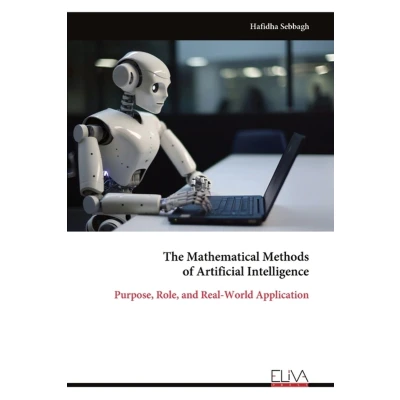
The Mathematical Methods of Artificial Intelligence Purpose, Role, and Real-World Application Beneath every chatbot, recommendation engine, and image classifier lies not a single mysterious algorithm - but a small, precise set of mathematical methods, each doing a specific job. This book names them, explains them, and shows exactly where they work inside systems you use every day. "The mystery, on inspection, resolves into a toolkit - and this book is a guide to the tools." Twelve chapters, one method each. Linear algebra encodes a Netflix film as a vector of hidden tastes. Calculus finds the direction of improvement inside a training loop. Gradient descent walks that direction, step by step, until a language model learns to predict language as people actually write it. Probability turns uncertain evidence into a Gmail spam decision. Information theory supplies the very measure of error that trains ChatGPT. And logic - the oldest method of all - still guarantees, with mathematical certainty, that aircraft software will never fail in a way no test ever caught. Every chapter follows the same structure: definition · purpose · role in AI · key formulas · one real system. Read in sequence, the chapters build from foundation upward. Read singly, each stands as a self-contained reference. No advanced background is assumed beyond basic algebra and a willingness to read an equation as a compact sentence. Inside this book: Linear algebra ¿ Netflix recommendations · Calculus ¿ Image classifier training · Gradient descent ¿ GPT-family LLMs · Probability ¿ Gmail spam filter · Statistics ¿ A/B testing at scale · Information theory ¿ ChatGPT word prediction · Regression ¿ Credit scoring (FICO) · Distance & similarity ¿ Spotify playlists · Neural networks ¿ Voice assistants (Siri) · Dimensionality reduction ¿ Eigenfaces & face ID · Graph theory ¿ Google PageRank · Logic & symbols ¿ Formal verification.
 Prijshistorie
 * Prijshistorie bevat geen data van Amazon, Amazon Marketplace.
Prijzen voor het laatst bijgewerkt op:
 Gerelateerde resultaten
 Productspecificaties


