

€ 33,50 Gratis verzending

Uitgelicht
|
|
33,50 |
Naar shop
|

|
33,50 |
Naar shop
|

|
33,50 |
Naar shop
|
| VERGELIJK ALLE AANBIEDERS (3) | ||
 Beschrijving
Vergelijk aanbieders (3)
€ 33,50 Gratis verzending
€ 33,50 Gratis verzending
€ 33,50 Gratis verzending
Winkels met andere maten
Beschrijving
(1)
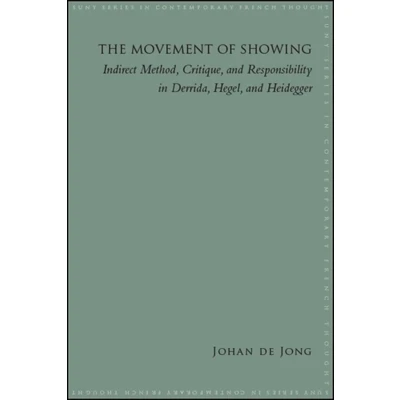
Explores why Derrida, Hegel, and Heidegger conceive their thought as a "movement" rather than as a presentation of results or conclusions, and of the consequences of such an indirect method for critique and responsibility. This book explores the idea shared by Derrida, Hegel, and Heidegger that the value of their thought is not found in its results or conclusions, but in its "movement." All three describe the heart of their work in terms of a pathway, development, or movement that seems to deprive their thought of a solid ground. Johan de Jong argues that this is a structural vulnerability that is the source of its value, tracing Derrida's indirect method from his early to later works, and critically considering his engagements with Hegel and Heidegger. De Jong's analysis locates an affinity among Hegel, Heidegger, and Derrida in a shared distrust of externality and, against the grain of some Levinasian commentaries, argues that Derrida's indirectness results in an ethics of complicity. The Movement of Showing answers a central question that many polemics about continental philosophy and postmodernism revolve around, namely: with which methods does one philosophize responsibly? It shows the difference between critique and polemics, and why simply taking up a position for or against is insufficient in order to think responsibly.
 Prijshistorie
 * Prijshistorie bevat geen data van Amazon, Amazon Marketplace.
Prijzen voor het laatst bijgewerkt op:
 Gerelateerde resultaten
 Productspecificaties


