

€ 28,10 Gratis verzending

Gesponsorde links
|
|
28,10 |
Naar shop
|

|
29,99 |
Naar shop
|
| VERGELIJK ALLE AANBIEDERS (2) | ||
 Beschrijving
Vergelijk aanbieders (2)
Gesponsorde links · Sommige shops betalen ons een vergoeding
€ 28,10 Gratis verzending
€ 29,99 Gratis verzending
Winkels met andere maten
Beschrijving
(1)
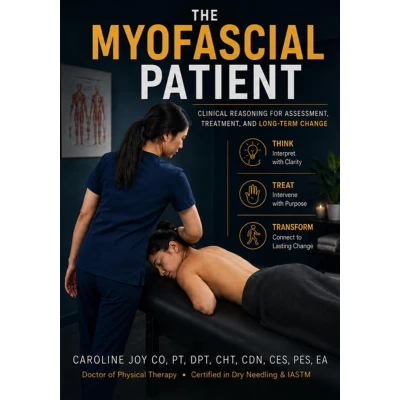
A tender point can be clinically meaningful without being the whole diagnosis.The Myofascial Patient is an advanced guide for physical therapists and rehabilitation professionals who want to use hands-on care, physical agents, and exercise without allowing any technique to replace reasoning.Rather than treating every "knot" as a local tissue problem, Caroline Joy Co shows how to interpret myofascial findings within the patient's history, symptom behavior, irritability, differential diagnosis, load tolerance, nervous-system sensitivity, recovery, goals, and participation.Readers learn how to: - Distinguish dominant, secondary, compensatory, protective, sensitized, and incidental myofascial findings - Select a meaningful comparable sign and use immediate and delayed re-testing - Match treatment intensity to irritability and response - Choose among manual compression, positional strategies, dry needling, IASTM, cupping, shockwave, photobiomodulation, taping, heat, stretching, and other adjuncts - Integrate symptom relief with movement, loading, education, and self-management - Recognize when regional symptoms require broader screening, referral, or a revised working explanation - Document clinical decisions with appropriate safety, consent, and scope boundariesRegional chapters address cervical, shoulder-girdle, thoracic and rib, lumbar, hip and pelvic, lower-extremity, and upper-extremity presentations. Seven author-created composite cases follow reasoning across multiple visits, including contradiction, reclassification, progression, recurrence, and return to meaningful activity.This is not a trigger point atlas or a protocol book. It is a practical clinical reasoning text for clinicians who want to treat the point when it matters, look beyond it when necessary, and use every intervention as part of a larger path toward function, confidence, and independence.Part of The Clinical Reasoning in Physical Therapy Series.
 Prijshistorie
* Prijshistorie bevat geen data van Amazon.
Prijzen voor het laatst bijgewerkt op:
 Gerelateerde resultaten
 Productspecificaties


