
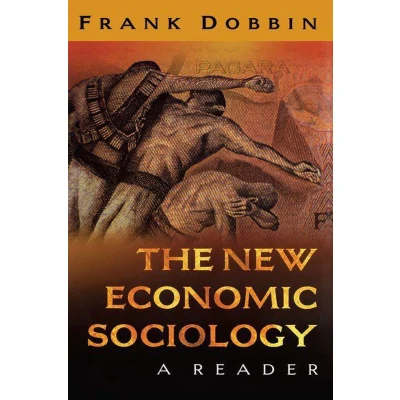
The New Economic Sociology
Uitgelicht

|
12,98 |
Naar shop
|

|
51,87 |
Naar shop
|
| VERGELIJK ALLE AANBIEDERS (2) | ||
 Beschrijving
Bol Partner
As the American economy surged in the 1990s, economic sociology made great strides as well. Economists and sociologists worked across disciplinary boundaries to study the booming market as both a product and a producer of culture, tracing the correlations they saw between economic and social phenomena. In the process, they debated the methodological issues that arose from their interdisciplinary perspectives.The New Economic Sociology provides an overview of these debates and assesses the state of the burgeoning discipline. The contributors summarize economic sociology's accomplishments to date, identifying key theoretical problems and opportunities, and formulating strategies for future research in the field. The book opens with an introduction to the main debates and conceptual approaches in economic sociology. Contributor Neil Fligstein suggests that the current resurgence of interest in economic sociology is due to the way it brings together many sociological subdisciplines including the study of markets, households, labor markets, stratification, networks, and culture. Other contributors examine the role of economic phenomena from a network perspective. Ron Burt, for example, demonstrates how social relationships affect competitive dynamics in the marketplace. A third set of chapters addresses the role of gender in economic sociology. In her chapter, Barbara Reskin rethinks conventional notions about discrimination and points out that the law only covers one type of discrimination, while in recent years social scientists have uncovered other forms of hidden discrimination, which must be addressed as well.The New Economic Sociology also addresses the problem of economic development and change from a sociological perspective. Alejandro Portes and Margarita Mooney elaborate on one of the key emerging concepts in economic sociology, arguing that social capitalas an attribute of communities and regionscan contribute to economic and social well-being by fostering collaboration and entrepreneurship. The contributors concur that economic action must be interpreted through the cultural understandings that lend it stability and meaning. By rendering these often complex debates accessible,The New Economic Sociology makes a significant contribution to this still rapidly developing field, and provides a useful guide for future avenues of research.


 Beschrijving
(2)
Beschrijving
(2)
As the American economy surged in the 1990s, economic sociology made great strides as well. Economists and sociologists worked across disciplinary boundaries to study the booming market as both a product and a producer of culture, tracing the correlations they saw between economic and social phenomena. In the process, they debated the methodological issues that arose from their interdisciplinary perspectives.The New Economic Sociology provides an overview of these debates and assesses the state of the burgeoning discipline. The contributors summarize economic sociology's accomplishments to date, identifying key theoretical problems and opportunities, and formulating strategies for future research in the field. The book opens with an introduction to the main debates and conceptual approaches in economic sociology. Contributor Neil Fligstein suggests that the current resurgence of interest in economic sociology is due to the way it brings together many sociological subdisciplines including the study of markets, households, labor markets, stratification, networks, and culture. Other contributors examine the role of economic phenomena from a network perspective. Ron Burt, for example, demonstrates how social relationships affect competitive dynamics in the marketplace. A third set of chapters addresses the role of gender in economic sociology. In her chapter, Barbara Reskin rethinks conventional notions about discrimination and points out that the law only covers one type of discrimination, while in recent years social scientists have uncovered other forms of hidden discrimination, which must be addressed as well.The New Economic Sociology also addresses the problem of economic development and change from a sociological perspective. Alejandro Portes and Margarita Mooney elaborate on one of the key emerging concepts in economic sociology, arguing that social capitalas an attribute of communities and regionscan contribute to economic and social well-being by fostering collaboration and entrepreneurship. The contributors concur that economic action must be interpreted through the cultural understandings that lend it stability and meaning. By rendering these often complex debates accessible,The New Economic Sociology makes a significant contribution to this still rapidly developing field, and provides a useful guide for future avenues of research.
BolEconomic sociology is a rapidly expanding field, applying sociology's core insight--that individuals behave according to scripts that are tied to social roles--to economic behavior. It places homo economicus (that tried-and-true fictive actor who is completely rational, acts only out of self-interest, and has perfect information) in context. In this way, it places a construct into a framework that more closely approximates the world in which we live. But, as an academic field, economic sociology has lost focus. The New Economic Sociology remedies this. The book comprises twenty of the most representative and widely read articles in the field's history--its classics--and organizes them according to four themes at the heart of sociology: institutions, networks, power, and cognition. Dobbin's substantial and engagingly written introduction (including his rich comparison of Yanomamo chest-beaters and Wall Street bond-traders) sets a clear framework for what follows. Gathering force throughout is Dobbin's argument that economic practices emerge through distinctly social processes, in which social networks and power resources play roles in the social construction of certain behaviors as rational or optimal. Not only does Dobbin provide a consummate introduction to the field and its history to students approaching the subject for the first time, but he also establishes a schema for interpreting the field based on an understanding of what economic sociology aims to achieve.
 Productspecificaties
| EAN |
|
|---|---|
| Maat |
|
 Prijshistorie
Prijzen voor het laatst bijgewerkt op:
 Gerelateerde resultaten


