
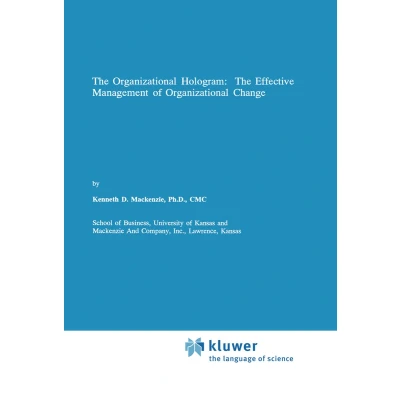
The Organizational Hologram: Effective Management of Change
Uitgelicht

|
199,00 |
Naar shop
|
| VERGELIJK ALLE AANBIEDERS (1) | ||
 Beschrijving
Bol
The prevailing wisdom is changing because many of our organizations are now or will soon be in a state of crisis. Because there are so many changes taking place, it is no wonder that there is continuous clamor for organizational change. Previously, the conventional wisdom about organizations was "If it's not broken, then don't fix it. " Today, the new dictum seems to be "If it works, make it work better. " There is a shift from a posture of reaction to one that embraces change. The prevailing wisdom is changing because many of our organizations are now or will soon be in a state of crisis. Every day we read about a proud old firm going bankrupt, manufacturers who must cut costs and retrench in order to survive, and failures in our governmental agencies. Who's next? Many organizations are failing but others are doing well. All wonder if something terrible could happen to their organization. Thus, it seems prudent to anticipate and proactively manage change rather than to passively sit by until some crisis strikes. All of us know that any organization can be improved. There will always be a gap between some desired state and our current reality. There will always be differences among people about what is desirable and what is not. Every change energizes these gaps. Because there are so many changes taking place, it is no wonder that there is continuous clamor for organizational change. These gaps and differences are the source of problems. Once a problem is recognized and agreed to, efforts are made to generate a solution to it. Every solution has both its intended and unintended consequences.


Vergelijk aanbieders (1)

 Beschrijving
(1)
Beschrijving
(1)
The prevailing wisdom is changing because many of our organizations are now or will soon be in a state of crisis. Because there are so many changes taking place, it is no wonder that there is continuous clamor for organizational change. Previously, the conventional wisdom about organizations was "If it's not broken, then don't fix it. " Today, the new dictum seems to be "If it works, make it work better. " There is a shift from a posture of reaction to one that embraces change. The prevailing wisdom is changing because many of our organizations are now or will soon be in a state of crisis. Every day we read about a proud old firm going bankrupt, manufacturers who must cut costs and retrench in order to survive, and failures in our governmental agencies. Who's next? Many organizations are failing but others are doing well. All wonder if something terrible could happen to their organization. Thus, it seems prudent to anticipate and proactively manage change rather than to passively sit by until some crisis strikes. All of us know that any organization can be improved. There will always be a gap between some desired state and our current reality. There will always be differences among people about what is desirable and what is not. Every change energizes these gaps. Because there are so many changes taking place, it is no wonder that there is continuous clamor for organizational change. These gaps and differences are the source of problems. Once a problem is recognized and agreed to, efforts are made to generate a solution to it. Every solution has both its intended and unintended consequences.
 Productspecificaties
| EAN |
|
|---|---|
| Maat |
|
 Prijshistorie
Prijzen voor het laatst bijgewerkt op:
 Gerelateerde resultaten


