


€ 25,99 Gratis verzending

Gesponsorde links
|
|
25,99 |
Naar shop
|

|
27,69 |
Naar shop
|

|
27,69 |
Naar shop
|
| VERGELIJK ALLE AANBIEDERS (3) | ||
 Beschrijving
Vergelijk aanbieders (3)
Gesponsorde links · Sommige shops betalen ons een vergoeding
€ 25,99 Gratis verzending
€ 27,69 Gratis verzending
€ 27,69 Gratis verzending
Winkels met andere maten
Beschrijving
(1)
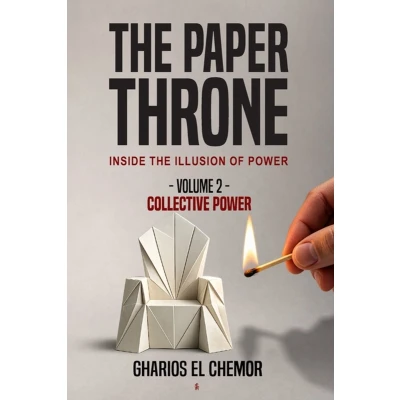
WHAT IF POLITICAL POWER IS REAL-BUT NOT IN THE WAY WE THINK?A president can order an army into battle. A judge can send someone to prison. A government can collect taxes, close borders, and transform millions of lives.Yet none of these people physically possesses "power."Power exists because human beings collectively recognize offices, laws, institutions, symbols, and authority-and behave accordingly.THE PAPER THRONE: COLLECTIVE POWER begins with this deceptively simple insight and follows it to its unsettling consequences.Drawing on political philosophy, history, psychology, and social science, Gharios El Chemor explores how authority is constructed, why apparently indestructible regimes can collapse with astonishing speed, how ritual and belief sustain political institutions, why democracies can confuse electability with competence, and why political systems repeatedly reproduce patterns of division, short-termism, sabotage, and decay.The book then turns from diagnosis to construction.Through structural legitimacy, the Power Coherence Index, the Triple Accord, Neo-Equilibrium, the Fifth Principle, moderator power, and Neo-Holism, it proposes a framework for evaluating political systems by something deeper than ideology or electoral victory: whether they preserve the long-term coherence of the societies they govern.The question is no longer simply: Who should possess power?It is: What is power-and how should we design the institutions that sustain it?THE PAPER THRONE: COLLECTIVE POWER is Volume II of a two-volume exploration of power, following Volume I: PERSONAL POWER.
 Prijshistorie
* Prijshistorie bevat geen data van Amazon, Amazon Marketplace.
Prijzen voor het laatst bijgewerkt op:
 Gerelateerde resultaten
 Productspecificaties


